Showing posts with label Malaysia. Show all posts

Tuesday, April 29, 2014

Malaysian Navy chief regrets lies about Scorpene submarines functions


Wikipedia:


The Royal Malaysian Navy (RMN) regrets action by certain parties who spread lies about the functions of the French made Scorpene submarines.The RMN chief, Admiral Tan Sri Abdul Aziz Jaafar said the submarine team had conducted their responsibilities to the best of their abilities and he was proud of them.

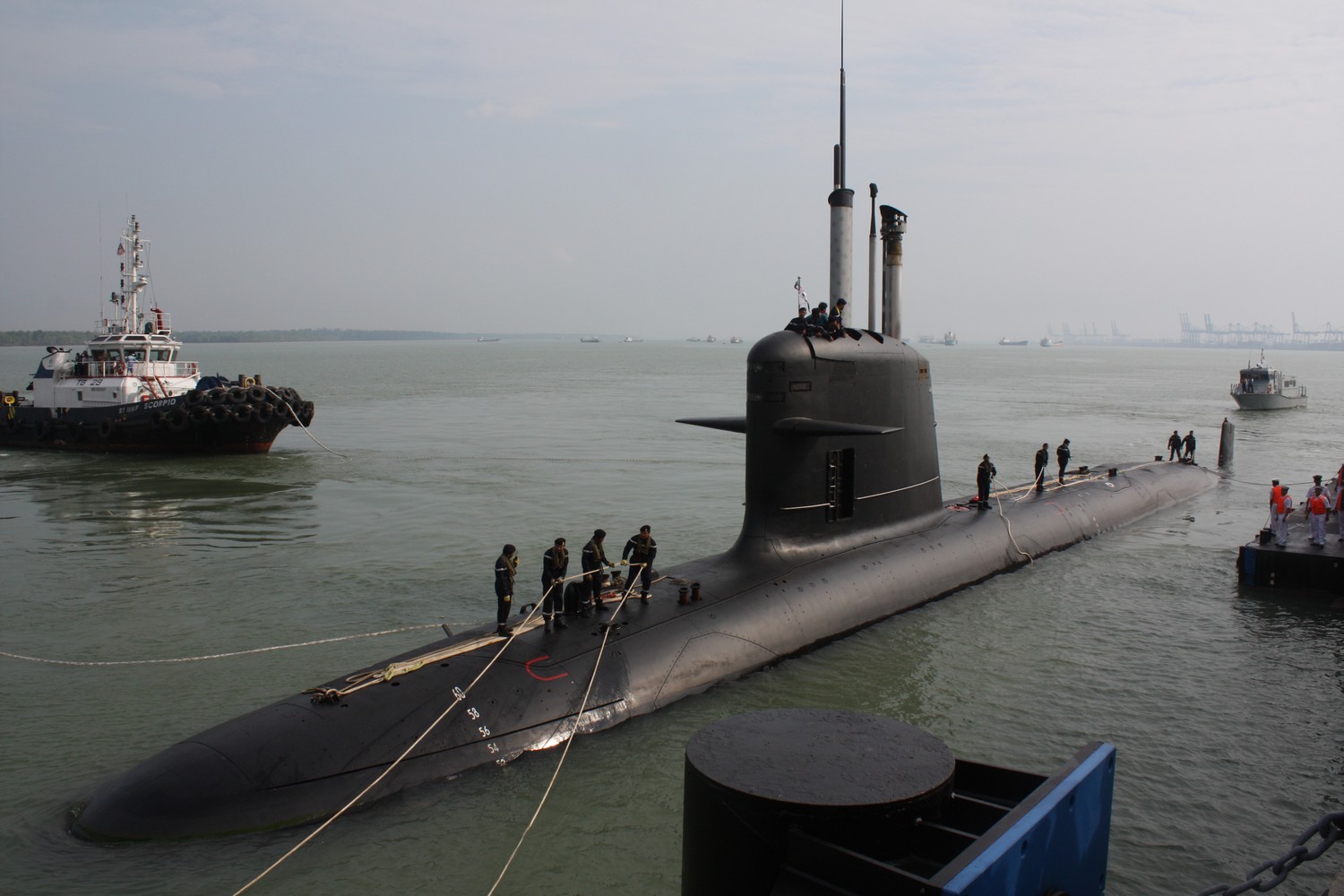
"As the navy commander, I am disappointed with the lies. The submarines and MV Mega Bakti submarine rescue vessel are brought here for public viewing during armada open day."Those who wrote negatively about assets of the country, especially the Scorpene submarines, must distinguish between reality and facts," he told reporters at the 80th anniversary celebration of the RMN, here today.Abdul Aziz said the French navy also praised the ability and efficiency of the nation's submarine team.

In another development, he said RMN vessels would continue to be involved in the search operation for Malaysia Airlines (MAS) flight MH370.The deployment of additional vessels in the search operation would be announced by the Deputy Minister of Defence, Datuk Abdul Rahim Bakri."I cannot make the announcement. The RMN role is to prepare equipment as requested by the government. We are always ready," he added.Media practitioners were today given the opportunity to board the KD Tunku Abdul Rahman (Scorpene) submarine and were briefed on its functions.The RMN bought two Scorpene submarines costing RM3.4 billion to enhance its ability to protect Malaysian territorial waters


http://www.nst.com.my/latest/navy-chief-regrets-lies-about-scorpene-submarines-functions-1.580519#ixzz30B2UEHJU

Friday, April 25, 2014

Royal Malaysian Navy's Scorpene submarine KD Tunku Abdul Rahman proves RMN's capabilities


The Royal Malaysian Navy's Scorpene submarine fleet, which has been a subject of discussion on social media recently, proved its naysayers wrong after KD Tunku Abdul Rahman submarine succesfully completed a week-long journey from its base in Sepanggar, Sabah to the Lumut RMN naval base here today.RMN Fleet Commander, Vice-Admiral Datuk Abdul Hadi A. Rashid said the seven day journey - which passed without incident - was proof that the navy's submarines were not as unreliable as painted by the online community.

"As you can see, there is absolutely no truth to the rumours that our submarines cannot manoeuvre underwater, as the submarine in front of us managed to circumvent the challenging South China Sea with no problems," he told reporters when met at the RMN Media Day at the Lumut Naval base here today.The submarine had made its way across the South China Sea in conjunction with the 80th anniversary celebrations of the RMN, where it will be opened to public viewing for the first time.

The ship's commanding officer Commander Zahari Mohamad urged the public not to spread lies about the nation's armed forces capabilities."Affairs involving the safety and protection of the nation should not be debated or politicised. Parties which spread these rumours are irresponsible," said Zahari, who has commanded the KD Tunku Abdul Rahman since August 2011.

He stressed that the submarines are only not operational during their maintenance periods, which involved a thorough and coordinated inspection of each submarine.Abdul Hadi, meanwhile, invited the public to visit the submarine during the RMN Armada Open Day and 1MINDEF carnival held at the RMN naval base here on Saturday and Sunday.

Abdul Hadi said that the open day would allow the public to see the capability of the RMN for themselves.In addition to the submarine, the public will also be able to see a number of RMN ships, including KD Hang Tuah, KD Selangor,KD Kelantan, Tunas Samudera royal yachts, and merchant vessel MV Megabakti, which is used as a submarine support vessel.

Hadi also said that the RMN special forces unit (PASKAL) would be showcasing rescue mission demonstrations for the benefit of the public.

Tuesday, April 22, 2014

Royal Malaysian navy needs modern assets

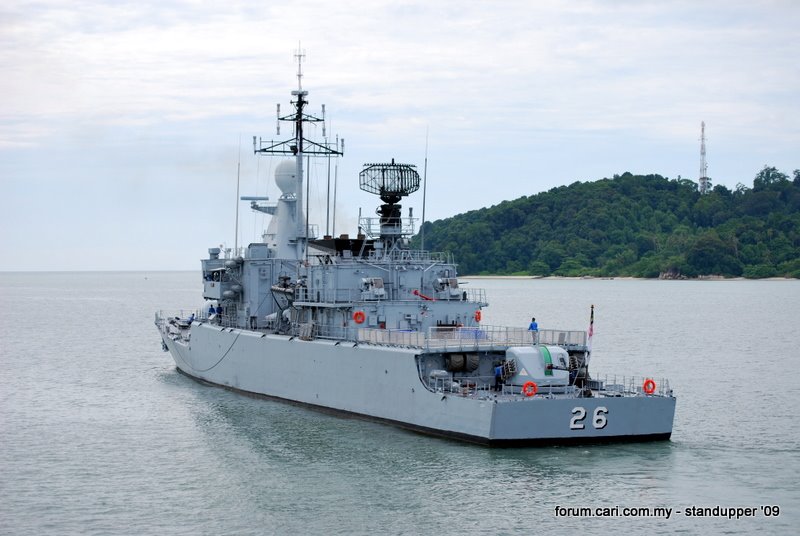
RMNS kasturi (26)-and-lekir(25)


KUALA LUMPUR: THE disappearance of Malaysia Airlines   flight MH370, the Lahad  Datu intrusion and yet another kidnapping in Sabah by Filipino militants have   boosted   calls to acquire new assets for the Royal Malaysian Navy (RMN).

RMN chief Admiral Tan Sri Abdul Aziz Jaafar said sophisticated technological assets were needed not just to protect the country's maritime territories, but also to boost search-and-rescue operations.
"To fulfil our geostrategic needs in the face of multilateral threats, we need to fortify ourselves with new-generation assets to enhance our capabilities as a formidable navy. RMN is turning 80 and it is time to heighten our preparedness against any spectrum of eventualities to protect our sovereignty," he said in an interview in conjunction with RMN's 80 anniversary on Sunday.

Short of implying that finances should no longer be an excuse for compromising safety and security, Aziz said there would be greater savings in the long run by replacing near-obsolete assets with modern equipment that required less maintenance.
One of the immediate measures RMN had undertaken, he said, was the service life extension programme (SLEP) for the 30-year-old frigates KD Kasturi dan KD Lekir.

SLEP involves the upgrades and refurbishments of its anti-ship armaments, radar, sonar and navigation equipment.By 2019, RMN will take delivery of the first of its six littoral combat ships to complement its six new-generation patrol vessels.

Aziz said the celebration's theme would be "Preparedness to Protect the Waters".Of special significance will be the conferment of pennants to the naval special forces base KD Sri Semporna in Sabah and the diving and mines warfare centre KD Duyong in Lumut by Yang di-Pertuan Agong Tuanku Abdul Halim Mu'adzam Shah, who is also commander-in-chief of the armed forces. Sultan of Selangor Sultan Sharafuddin Idris Shah, who is also RMN captain-in-chief, will attend the celebration.

http://www.nst.com.my/nation/general/navy-needs-modern-assets-1.575373

Saturday, April 19, 2014

DSA 2014 : Malaysia's SME Ordnance (SMEO) in talks with Philippines over M-4 carbine deal


Malaysia's SME Ordnance (SMEO), a subsidiary of the NADI group, is in talks with the Philippines' Government Arsenal on a joint venture over SMEO's licenced-built M-4 in order to meet the Armed Forces of the Philippines' requirements for the carbine.

Colt has licenced SMEO to manufacture the M-4 for domestic use and for ASEAN countries already using the weapon.General Mohd Sharom (rtd), NADI's Executive Director Defense & Business Development, told IHS Jane's at DSA 2014 that discussions were at an advanced stage and the joint venture would include the Government Arsenal manufacturing magazines of the M-4s to be produced for the Philippines.

http://www.janes.com/article/36735/dsa-2014-malaysia-s-smeo-in-talks-with-philippines-over-m-4-carbine-deal

Malaysia Bought Belgian Rockets for $12 Million


70 mm rocket and the launcher (photo : Dammit)

The Malaysian government has concluded with Malaysian Destini Prima contract for the supply of unguided rockets FZ 90 caliber 70 millimeters totaling 40 million ringgit ($ 12.3 million), according to Jane's. These munitions were developed in the early 1990s, the Belgian company Forges de Zeebrugge and manufactured in Malaysia under license.

In addition to the rocket itself Malaysian Government also ordered the suspension launch canisters for them. New ammunition is planned to equip F/A-18 Hornet fighter and trainer aircraft BAE Hawk. According to the Ministry of Defence Malaysia, rocket FZ 90 will be used to fight the rebels in the east. Cheaper ammo you plan to use instead of expensive JDAM.

Decision to purchase FZ 90 was adopted after the armed forces of Malaysia held in March 2013 operation to liberate the village from the rebels in the east. During the operation resets bombs JDAM, and corrected by laser beam weapons.


http://lenta.ru/news/2014/04/18/rockets/

Thursday, April 17, 2014

Malaysia Pushes Ahead with Tactical Vehicle Masterplan


AM General HMMWV (photo : Miltech)
Deftech has agreed to a partnership with US vehicle manufacturer AM General to produce light tactical platforms for the Malaysian Armed Forces (MAF) and law enforcement organisations, it was confirmed today.

Formally signed at the Defence Services Asia (DSA) exhibition on 16 April, the tie-up comprises a co-production, supply and distribution agreement.

The collaboration will see both companies as prime contractor and systems integrator to MAF and law enforcement units for the supply of High Mobility Multipurpose Wheeled Vehicles (HMMWVs) and other ‘offerings’ from AM General’s family of light tactical vehicles.

The deal will see the provision of right-hand drive HMMWVs, a feature which AM General recently began to offer to its international customers.  Malaysia currently owns an undisclosed number of HMMWVs in left-hand drive configuration. The vehicles are mounted with automatic grenade launchers or heavy machine guns.


Meanwhile, AM General was exhibiting its latest tactical vehicle- the M1165 (2.0) Deployable Reconnaissance Ground Network-Vehicle- for the first time in Malaysia. Claiming 70 percent commonality with the baseline HMMWV platform, the vehicle is designed to be deployed from cargo helicopters into ‘tight urban and harsh jungle and desert environments’, a company spokesman told Shephard. The vehicle is 2.2m wide, boasts a turning radius of 7.62m and has a top speed of 120kph.

Finally, Deftech confirmed to Shephard that MAF are in the middle of user qualification tests for its 8x8 AV8. Furthermore, MAF have just received the latest sealed pattern variant complete with 30mm weapon system which is expected to commence endurance, mobility and firing tests next month.

Selex to support Malaysian Navy’s Super Lynx MK100 helicopters


Selex ES, a Finmeccanica company, has been awarded a contract by AIROD SDN BHD for the supply and support of equipment onboard the Royal Malaysian Navy's Super Lynx MK100 helicopters.The contract was signed by AIROD CEO YBhg colonel Dato' Mohammed Selamat bin Bakin and Selex ES Asia regional director Barry Anstey at the Defence Services Asia (DSA) 2014 exhibition in Kuala Lumpur.

Under the three-year agreement, Selex will supply spares and provide support for the MK100's sensors, specifically the Guardian 2500 electronic-support measures, the Seaspray 3600 surveillance radar and the multi-mission turret.Barry Anstey said: "We are committed to deliver the Malaysian Navy our best expertise and are looking forward to further develop our relationship with the industry and the Government in Malaysia."

Powered by two Rolls-Royce Gem 42-1 turboshaft engines, the aircraft is fitted with a non-retractable tricycle-type landing gear and can carry a range of depth charges, including the Mark 11 and torpedoes such as the Mark 44, Mark 46, the A244S and the Stingray.Additional features include 360° scan radar, and either the BAE Systems (now Selex S&AS) Seaspray Mark 3000 or the Telephonics RDR 1500, which are mounted in the chin fairing under the nose.

Tuesday, April 15, 2014

Malaysian Defence Services Asia Exhibition and Conference 2014


DSME unveils its Missile Surface Corvette (MSC)


At DSA 2014, the 14th Defence Services Asia Exhibition and Conference currently held in Kuala Lumpur (Malaysia), Korean shipbuilder DSME introduces for the first time its Missile Surface Corvette (MSC). Navy Recognition learned during DSA 2014 that DSME teamed with a local partner to answer an RFI from the Royal Malaysian Navy for a small displacement corvette.

The MSC model shown at DSA 2014 is fitted with a 76mm Oto Melara main gun, 4x Kongsberg NSM anti-ship missiles, 2x MSI 30mm guns located aft, and several South Korean made sensors, most of them from Samsung Thales.

DSME representatives at the trade show stressed however that configuration is just a suggestion and that they are ready to adapt according to customer requirements.

SME's MSC has a length of about 85.5 meters, a breadth of 12.9 meters, a draft of 3.8 meters for a displacement of about 1,800 tons.

The MSC crew consists of 60 sailors. Its top speed is 26 knots and endurance in excess of 20 days.

DSME is also showing at DSA the DW3000 Frigate selected by the Royal Thai Navy. Thailand recently ordered two units of this class of ship from DSME to be delivered in 2018 and 2020. The displacement is about 3,700 tons.
------------------------------------------------------------------

C-28A model for Chinese Navy PLAN frigate`


Monday, April 14, 2014

Russia wants to sell Air Defense Systems for Malaysia


Malaysia is likely highly interested in acquiring Russia’s latest air defense missile systems, building on existing bilateral military-technical cooperation, Russia’s state arms exporter Rosoboronexport said Monday.

“Experts at Rosoboronexport expect an increased interest on the Malaysian side in the medium-range surface-to-air missile system Buk-M2E and the short-to-medium-range ground-based air defense system Pantsir-C1, the Kornet-E/EM and Metis-M1 anti-tank missile systems, and Mirazh, Sobol and Mangust class patrol boats,” the company said in a statement ahead of the DSA-2014 Asian International arms expo.
Rosoboronexport will discuss current and future projects with its Malaysian partners during the exhibition in Kuala Lumpur, which runs from Monday to Thursday.

“Mutually beneficial military-technical cooperation with Malaysia is developing quite dynamically. Russia has good prospects in aviation, primarily for multi-purpose fighter jets and military cargo helicopters, air defense systems, assault weapons and patrol boats,” said Nikolai Dimidyuk, the company's Director for Special Projects, who is heading the Russian delegation at the exhibition.
In addition, the expo will host a presentation of the Mi-171Sh combat transport helicopter for Malaysian officials, in addition to talks on the operations of a service and repair center for Sukhoi Su-30MKM fighters.

Sunday, April 13, 2014

Malaysian Air Force needs sophisticated aircraft for SAR ops


The Royal Malaysian Air Force (RMAF) has proposed that the government raised the capacity of the Maritime Patrol Aircraft (MPA) by equipping them with sophisticated technology for search and rescue (SAR) operations in future.

Royal Malaysian Air Force (RMAF) chief, Tan Sri Rodzali Daud said the need for sophisticated MPA with a high capacity was most urgent to carry out various missions by taking the search operation for the Malaysia Airlines (MAS) flight MH370 as a lesson.He said sophisticated MPA was also capable of carrying out SAR operations at sea level as well as on the seabed compared to the limited capability of the C-130 Hercules owned by the RMAF which are involved in the search for the MH370 in the south Indian Ocean.

“The Maritime Domain Awareness (MDA) aircraft that we have now is the Beechcraft King Air B200, but the extent of its operational capacity does not allow it to carry out SAR operations in the Indian Ocean, but only over the Straits of Melaka and the South China Sea,” he said.He said this to reporters at the Passing Out Parade for pilots at the Air Force College (KTU), here today.On the search mission for the flight MH370 in the Indian Ocean, he said the mission was most challenging due to the distance of the search area which was between 2,000 and 2,500 km from the Royal Australian Air Force (RAAF) Base in Pearce, Perth, Australia.

“Three C130 aircraft are involved in the SAR mission where the journey to the search location and back takes eight hours, leaving only two hours for the search.“This is a challenge that we must all go through and everything is running smoothly and we hope this operation will conclude successfully,” he said.


http://www.themalaymailonline.com/malaysia/article/rmaf-need-sophisticated-aircraft-for-sar-ops-says-rmaf-chief

Thursday, March 20, 2014

Cash-Strapped Malaysia Looks To Lease Fighters


Defense companies from Europe and the US are offering leasing options to Malaysia, which is looking to replace its MiG-29 fighter jets. (AFP/Getty Images)
Malaysia’s proposed purchase of fighter jets has switched from a procurement competition to a leasing competition due to affordability issues, according to industry executives.The Malaysian government put its multirole combat aircraft program in the freezer last year for fiscal and political reasons. Now Boeing, BAE Systems and Saab have, or are about to, submit leasing proposals in the hope of making a deal palatable.It’s possible Dassault Aviation and Sukhoi, which were also on the original procurement shortlist, are in a similar position, according to executives on the sidelines of the Singapore Airshow last week.

“The Malaysian government are mindful of the need for an affordable solution, so we understand that all the competitors are putting offers on the table for leasing. The program has become very much about affordability,” said Alan Garwood, BAE’s group business development director.Until recently, the Royal Malaysian Air Force had been looking for a straight purchase of a new jet to replace 18 aging MiG-29 fighters, due to leave service next year.

But Malaysian budgets are under pressure to be cut, making it politically difficult to approve a multibillion-dollar deal for a fighter while the administration is cutting subsidies on items such as food and fuel while hiking taxes.An industry executive asked whether Malaysia has the political will to make any kind of selection at this time, leasing or otherwise.“The political debate is more about the cost of living, so you wonder whether it is the best time to be looking for investment in defense equipment. So timing is very difficult,” he said. “Higher up in government, do they care about the problem? The MiG-29s are due to go out of service, but they could hang on for a couple more years. That’s an Air Force problem, but they won’t be driving the replacement timelines on this.”

The new jets, if they arrive, will complement the Boeing F/A-18D and Sukhoi Su-30 fleets in service with the Royal Malaysian Air Force.“Saab has put an offer on the table for the Gripen. Boeing is about to with the F/A-18 and BAE with the [Eurofighter] Typhoon won’t be far behind. I imagine the French and probably the Russians are doing the same. We hope it’s about leasing and a purchase later on,” an executive said.

“Everybody thinks that whatever Malaysia leases will eventually become the long-term solution because the Air Force will have already invested in infrastructure items like bases, spares and training,” Garwood said.Leasing civil airliners like the Boeing 737 is big business, but in the fighter world, it’s a rare event. Sweden’s Saab is the only top-line combat jet supplier involved in leasing, with existing deals with the Czech Republic and Hungary for the Gripen for several years.Teal Group analyst Richard Aboulafia reckons that Saab’s experience in fighter leasing could give it the edge in Malaysia.“They have planes to spare, they know how to structure this kind of deal and have a good presence in the region,” he said.Neighboring Thailand is operating the Gripen, having purchased 12 of the single-engine combat jets.

The current leasing arrangements involve Saab upgrading spare Swedish Air Force Gripen C and D models. It’s likely that a similar formula is being offered to Malaysia.The Swedish company submitted its leasing option as long ago as 2012. Rival bidders were dismissive of the move at the time, but now, everybody is following Saab’s initiative.Even Garwood admits to being surprised at the turn of events.

“I wouldn’t have thought we would be talking leasing, but it’s changed over the last year,” he said at the air show on Feb. 11.Garwood’s not saying what the British offering will be, but analysts say it will most likely involve secondhand Royal Air Force Tranche 1 aircraft.The BAE executive said that whatever Typhoon model is offered, it will be equipped with a new anti-ship capability — a key Malaysian requirement.The UK’s diplomatic relations with Malaysia have improved since the Conservative-led coalition government of Prime Minster David Cameron came to power in 2010.BAE opened a cyber center in Malaysia recently in a move that buoyed the relationship.Boeing’s product offering isn’t clear. It has a choice of spare F/A-18D Hornets or, more likely, new Super Hornets similar to the aircraft operated by the US Navy.Jim Armington, Boeing’s vice president for business development in the region, wouldn’t discuss the product strategy when asked the question at the show.

He did say, though, that Boeing prefers a straight purchase arrangement, but would respond to what the customer needs and can afford.Not everybody agrees with Aboulafia over who has the edge in the competition. Some believe it is Boeing.“I assume Boeing has an advantage from being in country already. They have a maintenance operation, a local partner and the Air Force is familiar with the F/A-18,” a second executive said.“There is, though, the political dimension,” the second executive said. “Will the US be the right choice politically? President Obama is going to Malaysia next month. That could be a turning point in either direction.”Speaking to reporters at the show, Boeing’s Armington declined to voice an opinion on the timing of a possible deal, beyond saying, “Hopefully within the course of the year, we will see some decision.”Like other executives here, Armington concedes that the timing of any decision will likely not be paced by Royal Malaysian Air Force requirements.“The fighters do need to be replaced from the point of view of the Air Force,” he said. “But it’s a national decision. It’s domestic politics and economics. Despite the concerns and urgency from the Air Force, there are other factors at play.”

Whoever comes out on top, Aboulafia says he believes that for some fighter markets with “pressing recapitalization needs and limited financial resources, leasing might catch on.”Financial tightening in the region is causing some people to wonder whether other programs will feel the pinch in a similar fashion to the Malaysian fighter.Garwood said the squeeze on financial resources in Southeast Asia means “growth is not at the levels people have been predicting. ... there is, though, a massive amount going on in Japan, South Korea and Taiwan.”

Dan Darling, the Asian and Pacific Rim market analyst at Forecast International, a US consulting firm, said that with the exception of Indonesia and Singapore, defense spending in Southeast Asia “remains largely restrained.“Because of the conflux of geopolitical pressures bearing down on the region, any slowdown in the local, regional or global economy is unlikely to result in an abrupt downturn in defense investment,” the analyst said.Darling said, though, that spending is already slowing.“According to our estimates from 2010 to 2011, defense spending in the Asia-Pacific region grew by $31 billion, [a] 16 percent year-on-year increase, while from 2012 to 2013, the level of growth totaled $14.4 billion,” or 6.2 percent, he said.“Our tentative estimates for regional defense spending from 2013 into 2014 reflect another slower rise in overall growth, with military investment increasing by $16 billion overall, with a little over half of that attributable to China, or 6.5 percent,” Darling said.

The analyst said he anticipates relatively consistent — but steadily upward — year-on-year defense spending for the region, largely driven by China, but to a lesser extent also by Indonesia.“As China increases its military might and reach, neighbors as diverse as Japan, India, the Philippines and Vietnam are mapping out fresh modernization plans to achieve satisfactory levels of deterrence,” he said. “Even countries such as Malaysia, which maintains healthy relations with Beijing, have recognized the need to upgrade their hardware in light of China’s growing strength and increasingly assertive territorial claims in the East and South China seas.”


Tuesday, February 18, 2014

Malaysia selects Thales SMART-S Mk2 radar and CAPTAS- 2 towed sonar confirmed for LCS program


CAPTAS- 2 towed sonar 
Thales SMART-S Mk2 radar

Thales announces that it has signed a Letter of Award with Contraves Advanced Devices Sdn. Bhd. to supply six SMART-S Mk2 naval surveillance radar systems, as well as six CAPTAS-2 towed sonar systems for the Royal Malaysian Navy’s Second Generation Patrol Vessel (SGPV) Littoral Combat Ships (LCS).

The six SMART-S Mk2 radars will be installed on the Malaysian Littoral Combat Ships that are currently being built by Boustead Naval Shipyard Sdn Bhd in Malaysia. The first SMART-S Mk2 is expected to be delivered within the next few years. Thales in Hengelo (The Netherlands) will build and test the first two radars; the other four systems will be assembled and tested by Contraves in Malaysia, using Thales components and know-how.

The Royal Malaysian Navy has also selected the CAPTAS-2 which is part of the CAPTAS1 family of Active Variable Depth Sonar (VDS). CAPTAS-2 is designed to perform against quiet submarines, enabling surface platforms to carry out all Anti-Submarine Warfare missions such as escort, prosecution, area sanitisation and own force protection.

The CAPTAS-2 Variable Depth Sonar comprises state-of-the-art innovative technologies that provides a high source level in a compact array. Furthermore, Thales’s unique towed triplet receive array provides instant left/right ambiguity resolution, and is ideally suited for torpedo defence.Thales is the European leader in naval radars and number one internationally for sonars and underwater systems. This new success confirms the position of the Group as a trusted partner to Navies worldwide.

Future Royal Malaysian Navy Littoral Combat Ships, based on French Shipyard DCNS' Gowind combat design, will be fitted with the following systems:
- BAE Systems Bofors 57mm stealth main gun
- SETIS combat management system
- Rheinmetall Fire Control Systems (TMX/EO Mk2 and TMEO Mk2) 
- MTU engines. 

The length of the LCS will be 111 meters with a displacement of about 3,000 tons. According to the general consens and rumors in the industry, the Malaysian "second-generation patrol vessels" will also come with:
- Thales Smart-S Mk2 radar
- Thales Captas 2 towed array sonar
- MSI-Defence 30mm guns
- MBDA Mica VL for air defense in VLS cells
- MBDA MM40 Exocet BlkIII anti-ship missiles


About SMART-S Mk2 

This contract raises the number of SMART-S Mk2 radar systems sold to well over 50. With the first system under contract in 2003 and operational in 2006, this radar is the world’s market leader in naval medium to long range 3D surveillance radar

About CAPTAS-2

Thanks to substantial investments into the development of the CAPTAS family, CAPTAS-2 has benefitted from the on-going evolution of Thales’s sea proven technologies, ranging from acoustic components to the most state-of-the-art software processing.

Within the last 20 years, more than €250M of Research & Development investment has allowed Thales to build an unprecedented expertise in very low frequency active towed sonars. Thales’s leading position in many fields such as wideband free-flooded ring transducers and triplet receive arrays, has enabled the company to develop the best Anti-Submarine Warfare tactical assets with the CAPTAS sonars. 

Operational at sea in major navies, the CAPTAS family is de-facto the world’s lowest frequency VDS standard with the largest installed base. It is also the only low frequency VDS servicing NATO countries and in service with multiple navies including the Norwegian Navy, the Royal Saudi Navy, the UK Royal Navy, the French Navy, the Italian Navy, the Royal Moroccan Navy and the UAE Navy. Furthermore, CAPTAS has been selected by the US Navy for an Advanced Demonstration Model (ADM).

Thursday, June 13, 2013

Datuk Raja Mohamed Affandi is Malaysian Army Chief from today

https://blogger.googleusercontent.com/img/b/R29vZ2xl/AVvXsEiRGeU9vHy2ra4G8edzlez7iBjLt3RYheGJoxZLGfjZVWAiCc9SudgHNiCvZF57w_BYioWg4bthV7DRSZFbjHXEtqNjp0opw87J1VO2aXOp2E4wKWcHHVuF7TQSioNIAK6OqNnnfdjVQ7I/s1600/ketua-staf-markas-atm.png 

  KUALA LUMPUR: Former Malaysian Armed Forces Chief of Staff Datuk Raja Mohamed Affandi Raja Mohamed Noor, 56, has been appointed Malaysian Army Chief effective Friday.
    Defence Minister Datuk Seri Hishammuddin Tun Hussien Raja Mohamed Affandi, 56, made the announcement during a ceremony held at the Wisma Pertahanan here in Kuala Lumpur.
    Raja Mohamed Affandi was promoted to full General during the ceremony.  He replaces Tan Sri Zulkifli Zainal Abidin, 52, who has been appointed as vice-chancellor of Universiti Pertahanan Nasional Malaysia (UPNM) effective Saturday. 

Wednesday, January 18, 2012

Malaysia becomes first export customer for Gowind corvettes


DCNS and its local partner Boustead Naval Shipyard have won a US$2.8 billion contract to supply six Gowind patrol vessels to Malaysia, in the type’s first export order. The first corvette will be delivered in 2017, with others following at six-monthly intervals.

In October 2010 Boustead received a letter of intent from the Malaysian government that requested it to build six second-generation patrol vessels. Boustead Naval Shipyard (BNS) was selected for the contract in early December last year,


However, the contract was put on hold for several days as BNS and DCNS wanted the vessel to carry the SETIS combat management system designed by DCNS, while the Royal Malaysian Navy wants the Tacticos systems, developed by Thales and integrated onto the navy’s KD Kasturi vessel.

DCNS competed with Dutch firm Damen and TKMS of Germany, which is one of the Malaysian navy’s traditional suppliers, having delivered six Meko corvettes between 2004 and 2010.

DCNS has already established a relationship with Boustead through a 2009 joint venture to maintain two diesel-propelled Scorpene submarines used by the Malaysian navy. DCNS previously sold six frigates to Malaysia's neighbour Singapore, five of which were built in Singapore.

The Gowind vessels are 100 metres long and displace 2 400 tons. They can each carry one medium helicopter (Eurocopter EC 725 Cougar) and will be fitted with a 57 mm gun, surface-to-air missiles and torpedo launchers.

The Gowind class is built under a DCNS-funded programme. The first ship, L'Adroit, was made available to the French Navy on October 21 last year as part of DCNS's ambition to win a larger share of the markets for small- and medium-displacement surface ships.

Over the next three years, the French Navy will thoroughly test the vessel, designed for current and emerging maritime safety & security missions, including fisheries surveillance, drug interdiction, environmental protection, humanitarian support and search and rescue at sea.

With two crews rotating every four months, L'Adroit will offer a high level of at-sea availability, spending 220 days a year on operational missions.

L'Adroit has a length of 87 metres, an at-sea endurance of more than 3 weeks and a range of 8 000 nautical miles. With a top speed of 21 knots, the vessel has a helicopter flight deck and can accommodate UAV operations. It is designed for reduced crewing, with a complement of 30 and space for 30 passengers.

Innovations and capabilities of special interest to ship-based naval, commando and coast guard forces include a panoramic bridge offering 360° visibility, a single enclosed mast offering 360° sensor visibility, covert deployment of fast commando boats in less than five minutes and full provision for unmanned aerial and surface vehicles (UAVs and USVs).