Showing posts with label Russian army. Show all posts

Tuesday, April 29, 2014

Kalashnikov Small Arms Production More Than Doubles


Wonder where all these small arms went to ?  A list of countries are given below.


The Kalashnikov Concern produced 230 percent more small arms weapons in the first quarter of this year than in the year-ago period, the company's press service told RIA Novosti Monday.
"In the first three months of the year we had a record-high volume production of small arms in the amount of 31,000 items, which makes 41 percent of the total output of similar products for 2013," the company said.
"The current results are 230 percent higher than those in the first quarter last year," the company added.
Positive dynamics was observed in most areas of production in the first quarter of this year.

"By the end of 2014 we expect the production of this product to increase by 27 percent compared to 2013, while in 2015 the growth should reach 17 percent compared to the previous year," the press-service added.
The Kalashnikov Concern was created in 2013 on the basis of the Izhmash and Izhmekh plants. It is now Russia's largest producer of automatic and sniper combat arms, guided artillery shells as well as a wide range of civil products, including shotguns, sporting rifles, industrial machines and tools.

The recently-formed Kalashnikov united a large number of state manufacturers of small arms weapons, and in the future a number of other plants will join the concern.The products manufactured by the concern are supplied to 27 countries, including the US, the UK, Germany, Norway, Italy, Canada, Kazakhstan and Thailand.

http://en.ria.ru/military_news/20140428/189431406/Kalashnikov-Small-Arms-Production-More-Than-Doubles.html

Monday, April 28, 2014

Russian army to use unmanned ground robot Taifun-M to protect Yars and Topol-M missile sites


The new Russian unmanned ground mobile security robot Taifun-M, designed to provide security at strategic missile facilities, has been shown on the Russian Vesti news program.The combat robots, which have no foreign analogue, will be used to secure RS-24 Yars and SS-27 Topol-M missile sites and can be operated remotely by a secure wireless connection and in the future with an autonomous artificial intelligence system, the program reported Monday.

A spokesman for the Defense Ministry said last month several of the robots, which feature laser-targeting and a cannon, will be deployed at five sites by the end of the year, part of an upgrade of existing automated security systems.The official said the robots will carry out reconnaissance and patrol missions, detect and destroy stationary or moving targets and provide fire support for security personnel at the guarded facilities.

Mobile robotic platforms play an increasingly important role in military and security applications, helping personnel to meet challenges posed by the growing threat of terrorist attacks or armed militants engaging in guerrilla warfare, while minimizing the risk of casualties.

Thursday, April 24, 2014

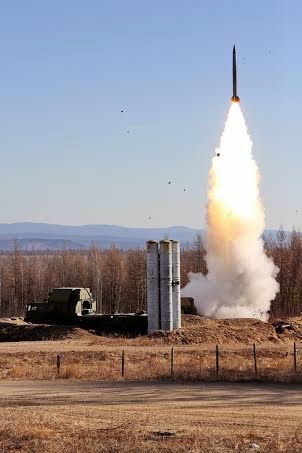
Russian Army to get new missile for upgraded Pantsir-S system by end of 2014

ITAR-TASS/Valery Sharifulin


The Russian army will get an upgraded version of the Pantsir-S air defense system and a new missile for it by the end of the year, Colonel Yuri Muravkin, deputy commander of the air defense troops, said on Wednesday, April 23.

“The modernization of the serial Pantsir-S systems with new missiles is underway now, and we expect to get them by the end of the year. It will be a new upgraded version of the serial system,” he said.

The new missile will increase the system’s range of fire from 20 to 30 kilometers. “The dimensions of the missile will be altered slightly but it will fit in as usual and no changes will be required. The missile is undergoing preliminary tests now,” Muravkin said.
In a firing exercise at the Ashuluk Range, Pantsir-S systems engaged targets imitating high-precision weapons. “While before we engaged low-speed targets, today we are trying to hit targets that are moving at a speed of 1,000 meters per second,” Muravkin said.
Yuri Savenkov, First Deputy Executive Director of the Tula-based KBP Instrument Design Bureau, which designs the Pantsir systems, said the high-speed missile for the system had been used during the tests at Ashuluk for the first time.Manufacturers will start supplying the new Pantsir-SM air defense system to the Russian army in 2017, Dmitry Konoplev, KBP Instrument Design Bureau Managing Director, said earlier.

A sea-based version of the system is also being developed. The first three Russian warships will be armed with it after 2016.
The Pantsir-S system designed for air defense of small military and administrative-industrial objects and areas against aircrafts, helicopters, cruise missiles and high-precision weapons, guided air bombs and unmanned aerial vehicles as well as for reinforcement of AD groups during repulse of massive air strikes and ensuring of engagement of lightly-armored targets.

Pantsir-S is considered to be a universal system capable to fighting planes, helicopters, ballistic and cruise missiles, guided aerial bombs, and other high-precision weapons. It can also be used for destroying underwater and surface light-armored targets and manpower.
The system consists of 12 surface-to-air guided missiles and two 30-millimetre automatic guns. It is provided with multi-range radar capable of detecting aerial targets with effective surface of dispersion of up to 2-3 square meters at a distance of more than 30 kilometers and track them down from a distance of over 24 kilometers.
It can also operate in a passive mode using an infrared channel in the long-wave band with logical processing of the signal and automatic tracking.

The system can conduct fire at two targets at the same time and attack up to 12 targets within a minute. The system's effective range for missiles is 20 kilometers and the maximum altitude is eight kilometers, and for artillery shells up to three and four kilometers respectively.

The probability of destroying the target is 0.6 to 0.8 depending on its type and obstacles. The time of response is 5-6 seconds.


http://en.itar-tass.com/russia/729304

Wednesday, April 23, 2014

Russia to build network of modern naval bases in Arctic – Putin


Russia will build a unified network of naval facilities on its Arctic territories to host advanced warships and submarines as part of a plan to boost protection of the country’s interests and borders in the region, President Vladimir Putin said Tuesday, according to RIA Novosti.“We need to strengthen our military infrastructure. In particular, to create in our part of the Arctic a unified network of naval facilities for new-generation ships and submarines,” the president said at a meeting of Russia’s Security Council.

He said that Russia should boost security at its Arctic borders.Putin ordered the military in December to boost its presence in the Arctic and complete the development of military infrastructure in the region in 2014.The Defense Ministry has already announced plans to reopen airfields and ports on the New Siberian Islands and the Franz Josef Land archipelago, as well as at least seven airstrips on the continental part of the Arctic Circle that were mothballed in 1993.
The military is also planning to form a new strategic military command in the Arctic, dubbed the Northern Fleet-Unified Strategic Command, by the end of 2014.

Putin reiterated that Russia is actively developing this promising region and should have all means for protection of its security and economic interests there.“The oil and gas production facilities, loading stations and pipelines must be well protected from terrorists and other potential threats,” Putin said.

The Russian president called on experts to defend Russia’s territorial claims to the Arctic shelf, just like they did during this year’s successful claim to 52,000-square-kilometer area in the Sea of Okhotsk off Japan.“Our experts must act similarly, for bilateral as well as multilateral consultations with Arctic countries’ governments, and safeguard each parcel of the continental shelf in the Russian part of the Arctic, and marine areas,” Putin said.

Monday, April 21, 2014

Ukraine submits proof of Russian covert action


The Mission of Ukraine to the EU made available today (16 April) information supporting what appears to be obvious: that Russian special forces are behind the actions of the paramilitary taking control of several cities in eastern Ukraine, whose uniforms have no national insignia. EurActiv publishes the information obtained, without edits.

The Security Service of Ukraine (SBU) has valid proof of Russian special-ops troops being deployed on Ukrainian territory. Officers of the Main Intelligence Directorate of the General Staff of the Armed Forces of the Russian Federation (GRU), currently based in the Donetsk and Luhansk regions, directly coordinating insurgents, providing them with financial, material and technical support. Militants are also being coordinated via special communications equipment from the the Russian Federation. For example:


  • Mr. Igor Strelkov a.k.a “Strelok”, identified as GRU staff, directly supervised the militant group on Ukrainian-Russian border on 12-13 April. On 11 April, in vicinity of Slovyansk this group conducted a ferocious and unprovoked attack on two vehicles with civilian license plates, killing one SBU officer and wounding three. During the Crimea crisis Mr. Strelkov worked as assistant on security issues to Sergey Aksionov, the puppet prime-minister of Crimea. In early April, he was relocated for further special operations to continental Ukraine. On multiple occasions he visited Russia’s Rostov-na-Donu and Moscow for instructions.


  • On 11 April, Ukrainian citizen Gontaryov, a leading pro-Russian separatist who participated, among other things in occupation of Donetsk Regional State Administration, dispatched an agent to Russia’s Consul-General. Point of discussion: support of Donetsk and Luhansk separatists.
  • On 13 April, a Russian citizen supervised training and redisposition of armed group of 30 militants from Luhansk to Donetsk region, who were instructed to provide armed resistance to Ukrainian law enforcement.
  • On 13 April, a Russian citizen instructed separatists via phone to deploy defectors among local Ukrainian police to control administrative buildings in Luhansk, to set up checkpoints within city line, to prepare for proclaiming a “Luhansk Republic” and forming a local parliament. Another Russian citizen instructed one of the separatist leaders who occupied the Regional Security Service in Luhansk to prepare for an emergency session of Luhansk Regional and City Councils.
  • Separatists held phone talks with Russian citizens regarding “a person who returned from Moscow headquarters”, “official” and “full Moscow support”, as well as plans of so-called “little green men” to appear in the respective regions on 13 April.
  • On 12 April, a phone conversation was intercepted regarding “a comrade from the Russian general who is here and will be here till the end, and he claims that in case of a shooting, Russian armed forces would enter Luhansk in 40 minutes or 1.5 hours”.
  • In Slovyansk, a professional GRU mercenary was identified who had earlier participated in Georgian events in 2008.
  • Two intelligence and raiding groups of GRU, currently based in Sevastopol, plan to move shortly to Odessa to coordinate the occupation of local administrative buildings.
  • Separatists who occupied administrative buildings in Donetsk region were armed with АК-100 rifles – a model used exclusively by Russian army and special-ops; their ammunition, combat training and tactics are also typical for Russian army and special-ops.
  • As an example, the model of shoes worn by armed insurgents is one manufactured by Butex, Russian enterprise that supplied Russian security agencies and stopped production about 6 months ago.
  • During the last month, 10 Russian spies and raiders who operated in Donetsk, Luhansk, Kherson, Odesa and Chernihiv regions were detained.


http://www.euractiv.com/sections/global-europe/ukraine-submits-proof-russian-covert-action-301601

Wednesday, April 16, 2014

Ukraine army's humiliations pile up as eastern push fizzles

Watch the word being used  pro-Russian rebels,  but we can see here are civilians.

NATO cannot and will not provide 'security'.


The humiliation on Wednesday of the Ukrainian army in its much-vaunted "anti-terrorist" push into separatist eastern territory makes an embarrassing string of failures even worse. Allowing pro-Russian rebels to seize six of its armoured personnel carriers and disarm its servicemen was evidence of a poorly planned and executed operation, analysts said.

They pointed out that the region, the Donbass, is hostile to Kiev's new, pro-EU leaders, and home to magnates and police reluctant to face down the separatists. "It was a mistake to launch an 'anti-terrorist operation' in the Donbass where the overwhelming majority is against the government. Targeted operations against armed groups is one thing, but when there are tanks in the street, people block them," said a Ukrainian political analyst, Volodymyr Fesenko. A military expert at the Razumkov think-tank in Kiev, Oleksiy Melnik, criticised the government for hesitating to use force and in the end sending in a smaller force than the one implied when it announced its "major operation" on Sunday.

"The arguments that 'We mustn't provoke Russia' are absurd in the current situation, because Russia needs no pretext to carry out its plan. The reason behind what happened is government inaction," he said. "The armoured vehicles were stopped by unarmed civilians, who they cannot shoot. That showed how badly thought-through the operation was, Melnik said. "These sorts of defeats are demoralising the army, whose fighting spirit has already been undermined by the events in Crimea," where Ukrainian soldiers ended up abandoning their units without offering any resistance to the Russian forces, he said.

Under-funded and possessing outdated weapons, the 130,000-strong Ukrainian army is easily overshadowed by the Russian one, which is six times bigger — and which currently has 40,000 men massed on Ukraine's eastern border, according to NATO.

Kiev asserts that the armed, pro-Russian rebels are being managed by Russian military intelligence officers on the ground. Several hundred trained military personnel carrying the sort of weapons used by Russia's elite forces and wearing uniforms stripped of any insignia can be seen in the region, but Moscow denies they are its soldiers.

Another military expert, Mykola Sungurovsky, said Ukraine has sent its best men and equipment to the border to protect it.

"But they are only capable of rebuffing a first assault. After that, they would need to turn to guerrilla actions because the balance of forces is not in our favour."

Several analysts observed that Ukraine's military is the main force loyal to Kiev's government in the east; the police, they said, did nothing to stop the pro-Russian assaults on public buildings and police stations in several towns in the region.

In Donetsk, the main city in the east, "the situation is very complicated," the interim first deputy prime minister Vitaliy Yarema acknowledged on Wednesday. "Some police officers are at the command of the separatists."

But Mykhaylo Kornyenko, a former deputy interior minister, said the police should not be blamed.
"Police stations were attacked by men with combat experience whereas they lack such experience. If they had used their weapons, the consequences could have been catastrophic." Olexandra Rudneva, an analyst at the Strategic Studies Institute, said, however, that many police are also bitter towards the new authorities for not punishing those responsible for the deaths of more than 100 people during the mass protests in Kiev early this year, and for being used as scapegoats for that bloodshed.

"In this situation, whoever is in power in Kiev would have a tough time exerting influence over the police, especially in Donetsk," she said.


Those "Russian Rebels" seem to be very friendly with locals. Russia has already won.


Tuesday, April 15, 2014

Russia Test-fires ICBM RS-24 Yars amid Ukraine Unrest


Russia has test-fired a strategic intercontinental ballistic missile (ICBM) amid the ongoing unrest in neighbouring Ukraine even as the west fears Moscow is gearing up for large-scale military intervention in the country.Moscow's Strategic Missile Forces test-fired the RS-24 Yars equipped with re-entry warhead from Plesetsk, 800km northeast of Moscow.

The launch took place at about 10:40am local time."The main task of the launch was to confirm the reliability of a batch of missiles manufactured at the Votkinsk plant, in Udmurtia," said Colonel Igor Yegorov, spokesperson for the defence ministry's Strategic Missile Force unit, reports ITAR TASS news agency.Moscow's latest test has come amid the deepening crisis in the eastern Ukrainian cities.The "large-scale anti-terror operation" by the Kiev administration against the pro-Russian protesters appears to have begun. Russia had earlier warned that Kiev's military action would have serious repercussions.

Monday, April 14, 2014

Russian fighter flies provocatively close to USS Donald Cook

We had reported about Donald Cook passing thru the straits

http://www.asiandefencenews.com/2014/04/uss-donald-cook-passing-through-turkish.html

US navy photo


As tensions between the West and Russia simmer, a Russian attack plane engaged in “provocative” acts Saturday towards the destroyer USS Donald Cook in international waters, the Pentagon announced Monday.

Over the course of about 90 minutes, a Russian SU-24 fighter jet made 12 “close-range, low-altitude” passes near the Cook while the ship was in international waters in the western Black Sea near Romania, Pentagon spokesman Col. Steve Warren told reporters.

Thursday, April 10, 2014

Satellite imagery of Russian troops and military equipment released by NATO


Here is some more satellite imagery of Russian troops and military equipment positioned within striking distance of the Ukraine released today by NATO:

Primorko-Akhtarsk Air Base. Pic: DigitalGlobe
                             

Belgorod. Pic: DigitalGlobe
 An alleged Russian artillery battalion. Pic: DigitalGlobe
The bases are in southern Russia - east of the Ukraine-Russian border - near Kuzminka, Belgorod, Yeysk, and Novocherkassk, east of the Sea of Azov.

Probable airborne or Spetznaz (special forces) brigade. Pic: DigitalGlobe
 However, Russia’s RIA news agency quoted the country’s military general staff as saying the pictures were taken in August last year.


Military tanks and infantry fighting vehicles. Pic: DigitalGlobe

Photos : NATO

Saturday, April 5, 2014

Russian army's communication, jamming and Electronic Warfare systems

These were used in Crimea


http://twower.livejorunal.com/


topwar.ru


The R-330ZH also named Zhitel is a jamming communication station designed and manufactured by the Russian Company Protek. The system is in service with the Russian army and deployed by the 18th motor rifle brigade. The R-330ZH jamming station was used by the Russian army during the Crimean crisis in March 2014.


Friday, April 4, 2014

Russian TOPOL M missile debuts at parade rehersal


TOPOL M

 Is he smelling it?


S-400 missile system                                                                  

Russia to display new weapons on Victory Parade in Moscow

Victory Day Parade on May 9 in Moscow

Wikipedia


Chrysanthemum-C

KAMAZ-63969 Typhoon-K

The press-service of the Russian Ministry of Defence said that new models of military equipment would be displayed during the Victory Day parade on Red Square in Moscow.Thus, on May 9, one will be able to take a look at state-of-the-art anti-aircraft missile complexes Tor-M2U and anti-missile systems Chrysanthemum-C.

Tor-M2U has already been put into service in a number of military units. The system can destroy cruise missiles, air reconnaissance and electronic warfare equipment.Chrysanthemum-C is capable of striking modern tanks of any level, as well as low-tonnage ships, hovercraft and low-flying air targets.

About 11,000 troops will take part in the Victory Parade in Moscow on May 9th, including about a hundred pieces of military equipment. Military vehicles, such as Tiger, BTR-82A, T-90A tanks, self-propelled howitzers MSTA-S, anti-aircraft missile systems Buk-M2, anti-aircraft missile and gun complexes Panzer-C1, antiaircraft missile systems S-400, as well as Topol-M will roll on the cobblestones of Red Square on May 9th at 10:00 a.m.

Monday, March 24, 2014

All Ukrainian military units stationed in Crimea are now under the control of the Russian army.


All military units stationed in Crimea are now under the control of the Russian military, and remaining Ukrainian servicemen are departing the peninsula, the region’s first deputy prime minister, Rustam Temirgaliyev, said on Monday, March 24, 2014.

As Crimea’s reunification process began last week, a total of 147 military units in the predominantly Russian-ethnic region have replaced Ukrainian flags with Russian ones and applied to join the Russian armed forces.“All Ukrainian military personnel have either joined Russia or are leaving Crimea,” Temirgaliyev said.

Shortly after Russian President Vladimir Putin signed a decree on Friday to ratify the reunification treaty, Defense Minister Sergei Shoigu said those soldiers wishing to continue their service with the Ukrainian armed forces were free to leave Crimea and will receive the required assistance to do so.
The Russian Defense Ministry said over the weekend that only 2,000 out of 18,000 Ukrainian troops serving in Crimea decided to leave the peninsula.On Monday, Shoigu appointed the former head of Ukraine’s navy as deputy commander of the Russian Black Sea fleet during a visit to Crimea.

Rear Adm. Denis Berezovsky swore allegiance to the people of Crimea earlier this month two days after he had been appointed commander of the Ukrainian navy by the country’s Western-backed government.

Tuesday, March 18, 2014

After the death today of one Ukrainian soldier the conflict enters a military phase


A Ukrainian soldier digs a trench on a checkpoint not far of the border with Crimea near the village of Strilkove
Ukraine's government says Russian forces stormed a military base in Crimea and killed a Ukrainian officer, escalating tensions in the region

Tensions in the disputed region of Crimea reached new heights Tuesday as Ukraine said a military officer was killed shortly after Russia formally annexed the breakaway peninsula.Interim Ukrainian Prime Minister Arseniy Yatsenyuk blamed Russian forces—whom he said stormed a Ukranian military outpost near the city of Simferopol—for the killing, and warned the conflict is “shifting from a political to a military stage.”

“Today, Russian soldiers began shooting at Ukrainian servicemen,” he said, according to AFP. “This is a war crime.”His claim could not be immediately verified, but if true, it would mark the first fatality in clashes between the two countries’ militaries during the weeks-long crisis in Crimea.Russian President Vladimir Putin, delivering a televised address to the country’s parliament on Tuesday, defended his country’s decision to absorb the region after it voted Sunday to split from Ukraine.

Thursday, March 13, 2014

Russian Tank Units and APCs Now Conducting Military Exercises Adjacent to Ukrainian Border


Russia said Thursday it was stepping up field training for tank, artillery and infantry units in three regions next to the Ukrainian border in a powerful display of military might.The move came as thousands of paratroopers also began exercises close to Ukraine on Thursday, while Russian gunmen patrol Crimea ahead of a referendum on it joining Russia on Sunday.

The armed forces are “increasing the intensity of field training exercises,” the defense ministry said in a statement, saying the exercises were being carried out in the Rostov, Belgorod and Kursk regions bordering Ukraine, as well as one non-border region.“The main aim … is a multi-faceted check of the units’ cohesiveness followed by the performance of battle training assignments in unfamiliar terrain and untested firing ranges,” the ministry said.

It said the exercises would continue until the end of March but did not specify how many troops were involved.Deputy Defence Minister Anatoly Antonov said Wednesday Moscow had permitted a request for a Ukrainian reconnaissance plane to carry out an observation flight over the border region.


Tuesday, March 11, 2014

Russian army's 98th airborne division begins large scale air drop exercises yesterday March 11 2014


http://en.wikipedia.org/wiki/98th_Guards_Airborne_Division


A Russian army's 98th airborne division based in Ivanovo in central Russia began large-scale exercises Tuesday, March 11, 2014. The Defense Ministry said units were put on high alert and moved to unspecified locations to “check readiness” in simulated combat conditions.

The drills come in the wake of a number of military exercises in Russia’s western regions in the past days, including air defense drills, combat readiness snap checks and a launch of an intercontinental ballistic missile.4000 troops, 36 military transport aircraft and an unspecified number of combat vehicles are taking part in the exercises, which will run until March 14.The drills will include a massive simultaneous aidrop involving 3,500 servicemen, the ministry said.

Russian officials say the exercises are not linked to the developments in Crimea.


Sunday, March 9, 2014

Russians in Crimea

Twitter/pic.twitter.com/uUqXgXRcRl/@ianbremmer


(below)Russia also lays red carpet for the US Destroyer Truxtun, by Moving Bastion Anti-Ship Missiles to Crimea

Unconfirmed news reports claim the Russian Navy is deploying land-based ‘Bastion’ anti-ship missile systems as a response to the recent U.S. move entering two naval vessels to the Black Sea. The two American Arleigh Burke class destroyer USS Truxtun (DDG-103) crossed the Bosphorus Strait Friday, headed into the Black Sea, as tensions simmer over Ukraine’s Crimea region. 

The Russians have also moved two naval combatants from the Mediterranean Task Force back to the Black Sea Fleet. Tension is mounting in the Crimea Peninsula with the preparations for a referendum on independence from Ukraine later this week.


Saturday, March 1, 2014

Ukraine troop deployment approved by Russian parliament


Russia's upper house of parliament has approved President Putin's request for Russian forces to be used in Ukraine.Russia's Black Sea Fleet is based in the Ukrainian region of Crimea, where many ethnic Russians live.
Ukraine has reacted angrily to days of military movements in Crimea, accusing Moscow of trying to provoke the new government into an armed conflict.
Ukrainian officials and some Western diplomats said that a Russian military intervention is already well underway after heavily armed gunmen in unmarked military uniforms seized control of local government buildings, airports and other strategic facilities in Crimea in recent days.