Showing posts with label US. Show all posts

Monday, May 5, 2014

U.S. Navy Continues Virginia-Class Sub Investments


As the U.S. Navy continues to tweak its redesigned Block III Virginia-class submarines, the service is pushing ahead with its Block IV Virginia plans, awarding a $17.6 billion contract this month to General Dynamics’ Electric Boat Corp for 10 subs between fiscal 2014 and 2018.“The Block IV award is the largest shipbuilding contract in U.S. Navy history in terms of total dollar value and builds upon the Virginia-class program’s successful Navy and industry relationship,” says Rear Adm. David Johnson, program executive officer for submarines.

Under the deal, Electric Boat will still subcontract part of the work to its submarine-building partner Newport News Shipbuilding, a unit of Huntington Ingalls Industries. The fixed-price incentive, multi-year contract calls for about 24% of the work to be done at Newport News.
The Navy confirmed April 16 that it is postponing the commissioning of the Block III Virginia-class attack submarine SSN-784 North Dakota to an undetermined future date because of “the need for additional design and certification work required on the submarine’s redesigned bow and material issues with vendor-assembled and delivered components.” The North Dakota was christened in November and was scheduled to be commissioned on May 31.

The Virginia-class submarines – considered by most inside and outside the Pentagon to be a model acquisition and shipbuilding program – rank as the third-costliest Pentagon program, with a total acquisition cost of about $84.4 billion, the U.S. Government Accountability Office reported recently.The proposed fiscal 2015 Navy budget includes about $5.9 billion for two more Virginia-class subs and continues to procure two Virginia-class SSNs per year through the five-year-defense plan, resulting in an inventory of 21 Virginia-class subs – of 48 total subs – by 2020.


http://aviationweek.com/defense/us-navy-continues-virginia-class-sub-investments

Sunday, May 4, 2014

US Air Force F 35A and F 16s Fighters Formation Flight


T-34C crashes off Gulf of Mexico


Two pilots aboard a training aircraft were uninjured Thursday morning after their plane crashed over the Gulf of Mexico, Naval Air Training Command said in a news release.The aviators, assigned to Training Squadron 28 at Naval Station Corpus Christi, Texas, escaped the T-34 Turbomentor aircraft and were recovered by Coast Guard search and rescue personnel, the release said.

The pilots were flying a routine training mission over the inter-coastal waterway when they crashed around 10:20 a.m., central time. They are currently under evaluation at a local hospital.The Navy will conduct an investigation into the cause of the crash, the release said.The VT-28 Rangers conduct primary flight training for new aviators on the single-prop T-34C trainer.


http://www.navytimes.com/article/20140501/NEWS/305010058/T-34C-crashes-off-Gulf-Mexico-no-injuries

Saturday, May 3, 2014

Carrier Abraham Lincoln marks overhaul milestone

Photo: Huntington Ingalls Industries


Huntington Ingalls Industries announced today that its Newport News Shipbuilding division recently placed a new upper-level structure on top of USS Abraham Lincoln's (CVN 72) island, which is similar to an airport control tower. The aircraft carrier is undergoing its refueling and complex overhaul (RCOH), during which the shipyard refuels the ship's reactors, paints the ship's hull, modernizes systems and performs a complete recapitalization of the entire ship.

The structure, which will contain the ship's primary flight control systems when outfitted and serves as the platform for many of its various radars and antenna systems, is one of the largest structure lifts that will be performed during the RCOH process. At 88 feet long and 32 feet wide, the structure weighs about 68 long tons, which is equal to the weight of nearly a dozen elephants. It was set into place using the 310-ton gantry crane that straddles dry docks 10 and 11.

"An RCOH is an extremely complex engineering and construction project that requires more than 30 months of advance planning and more than three years to accomplish," said Chris Miner, Newport News' vice president of in-service aircraft carrier programs. "This lift represents just one of many significant events we complete to return this ship to the Navy fully equipped and modernized to defend our nation for another 25 years. I applaud the thousands of shipbuilders who are working tirelessly to safely return this great ship to the Navy on schedule and within budget."

USS Abraham Lincoln arrived at Newport News in March 2013 and is on track to redeliver in 2016. RCOH is the mid-life refueling overhaul and maintenance availability of a Nimitz-class carrier that produces a recapitalized carrier capable of supporting current and future warfare doctrine and continuing to operate as the centerpiece of the U.S. Navy fleet and national defense for another 25 years.


http://newsroom.huntingtoningalls.com/News-Releases/Photo-Release-Newport-News-Shipbuilding-Installs-New-Upper-Level-Structure-on-USS-Abraham-Lincoln-3cb.aspx


Friday, May 2, 2014

U.S. KC-135 refuels Moroccan F-16 Block 52 jets during Aeroexpo Marrakech


A U.S. Air Force C-130J Super Hercules from the 37th Airlift Squadron based out of Ramstein Air Base, Germany and a KC-135 Stratotanker took part to the 2014 Aeroexpo Marrakech Trade Show.
These assets were chosen because “they are critical to the success of current and future multinational military operations in Africa.”

The importance of aerial refuelers in the region was also highlighted by the Libya War in 2011, when the U.S. had to support the air campaign with the majority of the tankers required to sustain the air strikes.
During its stay at the show, the KC-135 took also part to a training mission, during which it refueled three F-16 Block 52 jets from the Royal Moroccan Air Force as the images in this post show.

Thursday, May 1, 2014

LCS Fort Worth Completes Test as Congress Cools on Program


Navy officials told reporters yesterday the third Littoral Combat Ship recently completed a successful operational evaluation of its surface warfare technologies days after Congress slowed down the production rate for the vessel.The USS Fort Worth, the Navy’s third LCS, engaged in scenarios involving swarms of small boats, engagements with its 57mm gun, and search and seizure exercises, said Rear Adm. John Ailes, Program Executive Officer, LCS.

“We destroyed all the targets and the crew’s performance was excellent. It was a great event and we are pleased with all facets of the surface warfare mission package,” Ailes told Military​.com in an interview.
The House Armed Services Committee Seapower and Projection Forces subcommittee has proposed legislation that slows the rate of purchase for the LCS from three to two per year.The subcommittee supports the LCS program and the development of a new small surface combatant, but priorities such as refueling the USS George Washington and ensuring that the Navy can operate an 11-carrier fleet took precedence in the budget, said a congressional staffer close to the subcommittee.

The mark up is the latest in a series of setbacks for the controversial LCS program, which was truncated from 52 ships down to 32 by Defense Secretary Chuck Hagel in January of this year.Formal results and grades from the commander for the operational test that took place at the Navy’s Point Mugu test range in California are expected within 90 days, Ailes added.

The operational evaluation was designed to further develop the LCS’ increment 2 of its surface warfare mission package. The LCS is engineered to accommodate specific mission packages to include surface warfare, mine-countermeasures and anti-submarine warfare.
The LCS has two variants, the Freedom ships built by Lockheed Martin and the Independence ships built by Austal, US.


http://defensetech.org/2014/05/01/lcs-fort-worth-completes-test-as-congress-cools-on-program/


Raytheon developing the world's most advanced digital radar


The Office of Naval Research (ONR) has awarded Raytheon Company an $8.5 million base contract to design the Flexible Distributed Array Radar (FlexDAR), enabling dynamic multi-mission radars capable of executing a variety of functions including surveillance, communications and electronic warfare.

"Raytheon is a pioneer in radar development, pushing the limits of technology to achieve the best possible solutions for our customers," said Paul Ferraro, vice president of Raytheon Integrated Defense Systems Advanced Technology Programs. "Migrating digital technologies closer to the front end of radars will allow for more re-configurability and ultimately more flexible radars resulting in game-changing improvements."

The FlexDAR effort is being developed under the ONR Integrated Topside (InTop) Program as an innovation effort to demonstrate new capabilities provided by the implementation of every-radar-element-level digital beam forming, combined with network coordination and precise time synchronization.

FlexDAR will develop technology that will lead to enhanced capability for future radar sensors including software-defined digital re-configurability at the foundational level.  The program demonstrates both radar and radar-to-radar communications functions so as to implement bi-static exchange and control.  This provides increased detection and firm-track range, and improved electronic protection relative to existing standalone mono-static radars.

This first phase of the InTop FlexDAR program will design the radar front-end and will demonstrate all critical components and subassemblies. In the subsequent phase, Raytheon will build two identical multi-function array antennas that will be installed at ONR's Chesapeake Bay Detachment to demonstrate several important advantages of network-linked, distributed sensors and serve as foundations to test and explore next-generation radar capabilities.


http://raytheon.mediaroom.com/index.php?s=43&item=2556


Tuesday, April 29, 2014

U.S. F-15Cs performing Baltics Air Policing were scrambled on Monday to intercept a Russian Il-20.

Image credit: U.S. Air Force


According to the Latvia’s Military, the U.S. Air Force F-15C deployed to Šiauliai, Lithuania, to provide Air Policing in the Baltics region, intercepted an Il-20 spyplane.Russian Air Force missions in the area often requires NATO jet fighters to perform Alert Scrambles, to intercept Il-20 spyplanes, Tu-22M Backfire bombers and Su-27 fighter jets. Such close encounters have become a bit more frequent since Russian invasion of Crimea and subsequent international crisis over Ukraine.

On Feb. 24, two F-15Cs taking part to a flyby in Estonia were diverted to intercept a Russian plane before overflying the city of Pärnu.On Apr. 25, two Tu-95H bombers were intercepted by RAF Typhoons, Dutch and Danish F-16s during a long range patrol around UK.

Monday, April 28, 2014

U.S. Navy orders Block IV Virginia Class submarines worth $17 billion


The U.S. Navy awarded General Dynamics Electric Boats a record $17.645 billion contract today, Funding the construction of 10 new SSN 774 Virginia-class Block IV nuclear-powered attack submarines.“The Block IV award is the largest shipbuilding contract in US Navy history in terms of total dollar value,” said Rear Adm. Dave Johnson, program executive officer for submarines at Naval Sea Systems Command (NAVSEA). “The new contract would result in additional reductions in procurement costs and will also lower operating costs.”He added.

“The Navy and shipbuilders worked together to produce a contract that is both fair to the Navy and industry,” Johnson said. “This contract lowers the per-ship cost compared to Block III.” Johnson said the contract would also reduce the number of major maintenance visits for the submarines to three from four, which meant that each of the new subs would be able to carry out 15 full-length deployments instead of 14.“With the decrease in cost and the increase in capability, we are essentially getting more for less,” he said.

The Navy is already operating 10 Virginia-class submarines, with eight more submarines from the third block under contract.The order secures submarine building work at the prime contractor General Dynamics Electric Boat and chief subcontractor Huntington Ingalls Newport News Shipbuilding for the next four years, at a pace of two submarines per year. Each yard will deliver one sub per year.

And the largest number of boats ordered to date in a single contract block. The Block IV award covers hull numbers SSN 792 through SSN 801. None of the ships have yet been named. SSN 792 is funded in fiscal 2014. Construction of SSN 792, Electric Boat said, will begin May 1. SSN 801 is scheduled to be delivered to the fleet in 2023.Ten Virginia-class submarines already have been delivered and are in service, while another eight are under construction or on order. The North Dakota, first of the Block III group, is to be delivered this summer.

Each submarine displaces 7,800 tons submerged, with a hull length of 377 feet and diameter of 34 feet. They are listed as “capable” of speeds greater than 25 knots with a diving depth greater than 800 feet, while carrying Mark 48 advanced capability torpedoes, Tomahawk land-attack missiles and unmanned underwater vehicles.

Sunday, April 27, 2014

US drone crashes in Kunar


A US pilotless craft had crashed in eastern Kunar province, where the Taliban claimed their fighters had shot down the drone which destroyed into pieces, an official said Saturday.

The unmanned air-vehicle crashed in Shigal district of the province, where Chief Abdul Zahir said it had divided into pieces after crashing.A Hezb-e-Islami Hekmatyar (HIH) party spokesman, Zubair Seddiqi had claimed that their armed men had shot the aircraft down.
But, an eyewitness and area resident, Ruhollah said the drone had crashed in a remote area of the district, with the motive behind still unclear.

173rd paratroopers arrive in Poland

http://www.army.mil/article/124554/173rd_paratroopers_arrive_in_Poland/


a company-sized contingent of U.S. paratroopers from U.S. Army Europe's 173rd Infantry Brigade Combat Team (Airborne) from Vicenza, Italy, arrived in Poland to begin exercises with Polish troops.

This new exercise is the first in a series of expanded U.S. land force training activities in Poland and the Baltic region that are in addition to previously scheduled multinational land force military exercises such as Combined Resolve II, Saber Strike, Rapid Trident, and Saber Guardian. Exercises like this will take place for the next few months and beyond, and are aimed at assuring regional allies of the U.S.'s unwavering commitment to NATO.

In the coming days additional companies will move into Lithuania, Latvia and Estonia for similar exercises.

Friday, April 25, 2014

Northrop Grumman Completes Preliminary Design Review for B-2 Bomber Software Upgrade


Northrop Grumman Corporation has successfully completed a major U.S. Air Force review of a new software upgrade for the B-2 stealth bomber.The upgrade is part of the Air Force's Flexible Strike Phase 1 program. It is the first step in a process that will help increase the jet's mission capabilities and reduce its maintenance costs.

Northrop Grumman is the Air Force's prime contractor for the B-2, the flagship of the nation's long range strike arsenal and one of the most survivable aircraft in the world."We're simplifying the software used by the B-2 to manage its weapons," explained Dave Mazur, vice president and B-2 program manager, Northrop Grumman Aerospace Systems. "Today we have several standalone programs that each manage a specific type of mission. We're replacing that software with a single program that can manage all of those mission types."

The result, Mazur added, will be a more reliable, more affordable way to maintain the bomber's mission readiness.The preliminary design review (PDR) is the company's opportunity to show the Air Force that it understands the required interactions between the aircraft and its weapon systems, and that the new software will manage those interactions correctly. PDR was conducted Feb. 26-27 at Northrop Grumman's B-2 facility in Oklahoma City.

For the Flexible Strike Phase 1 program, the company plans to replace multiple operational flight programs (OFP) – embedded software that allows the B-2 to communicate accurately with the equipment that holds and dispenses its weapons – with a single OFP. The upgrade is expected to improve B-2 mission effectiveness.

The Flexible Strike program is the first B-2 modernization effort to take advantage of the enhanced communications infrastructure Northrop Grumman created for the first increment of the B-2 EHF satellite communications program. Those improvements included faster processors, a fiber optic network and increased onboard data storage, all of which help the bomber manage more information at higher speeds.

The B-2 is the only long-range, large-payload U.S. aircraft that can penetrate deeply into access-denied airspace, and the only combat-proven stealth platform in the current U.S. inventory. It can fly more than 6,000 nautical miles unrefueled and more than 10,000 nautical miles with just one aerial refueling, giving it the ability to reach any point on the globe within hours.

US Navy’s Electronic Attack Squadron Participates in Exercise Max Thunder


The U.S. Navy’s Electronic Attack Squadron (VAQ) 132 “Scorpions” participated in Exercise Max Thunder, a bilateral aerial training exercise for U.S. and Republic of Korea (ROK) military aircrews and maintainers April 23 at Gwangju Air Base.

Exercise Max Thunder is conducted annually to enhance bilateral air-combat capabilities that increase operational readiness and strengthen the U.S. and ROK alliance. The inaugural addition of the EA-18G Growler from VAQ-132 represented a historic first for Max Thunder, an exercise conducted primarily with U.S. and ROK Air Force assets.

Aircrews from VAQ-132 flew 60 sorties during Max Thunder, operating with their U.S. and ROK Air Force counterparts. Exercise missions were comprised of flight formations, air warfare drills and tactical maneuvers.VAQ-132 is currently on a routine deployment in support of U.S. Seventh Fleet operations in the Indo-Asia-Pacific region. The squadron is homeported at Naval Air Station Whidbey Island in Oak Harbor, Wash. Exercise Max Thunder is part of a continuous exercise program to enhance interoperability between U.S. and ROK forces and is not tied to any real-world or specific threats. These exercises highlight the longstanding military partnership, commitment, and enduring friendship between the two nations, help ensure peace and security on the Korean peninsula, and reaffirm the U.S. commitment to stability in Asia.

Thursday, April 24, 2014

Raytheon Recovering From Missile Delivery Delays, Air Force Says


Raytheon Co. (RTN:US) has recovered almost 30 percent of about $621 million withheld by the U.S. Air Force since 2012 because it missed deadlines for delivering missiles.

Raytheon, the world’s largest missile maker, received $179 million of the performance payments that had been held back as of March 5, Ed Gulick, a spokesman for the Air Force, said in an e-mailed statement. The funds were released under a revised delivery schedule agreed on in December 2012.Raytheon told the Air Force it expected to get back on schedule by July in delivering complete Advanced Medium-Range Air-to-Air Missiles (AMRAAM) after falling almost 900 behind schedule because subcontractor Alliant Techsystems Inc. had difficulty manufacturing the motor under the original milestones.

“We’ve been working very closely with Raytheon,” William LaPlante, the Air Force’s acquisition chief, said in an interview about the program. “Some things are getting better. We’ve turned the corner on that, but you are always discovering stuff and these are pretty advanced weapons.”

In addition to the missile, which is fired by pilots beyond visual range of an adversary, Waltham, Massachusetts-based Raytheon makes the Tomahawk cruise missile, the hit-to-kill warhead on the U.S. ground-based missile defense system and versions of the Patriot air defense interceptor.


http://www.businessweek.com/news/2014-04-23/raytheon-recovering-from-missile-delivery-delays-air-force-says


Wednesday, April 23, 2014

US Navy Deploys Raytheon’s Second-Generation SM-3 Block IB


In partnership with the Missile Defense Agency, the U.S. Navy deployed the second-generation Standard Missile-3 Block IB made by Raytheon Company for the first time, initiating the second phase of the Phased Adaptive Approach.

In 2009, the administration announced the U.S. decision to adopt a new, more flexible approach to missile defense of both the U.S. and Europe. The Phased Adaptive Approach (PAA) Phase 1 began in March 2011 when the USS Monterey deployed carrying SM-3 Block IAs.

In Oct. 2013, ground broke in Romania on the first operational Aegis Ashore site, which will be capable of launching SM-3 Block IAs, IBs and IIAs. The site continues on track for 2015 deployment as part of PAA Phase 2. Along with deployed Aegis Ballistic Missile Defense ships, Romania’s Aegis Ashore site will provide additional ballistic missile coverage of NATO countries. The first Aegis Ashore test with the SM-3 Block IB and upgraded Aegis BMD Weapons System will take place this year at the Pacific Missile Range Facility, Kauai, Hawaii.

Shoot 'Em If You Got 'Em


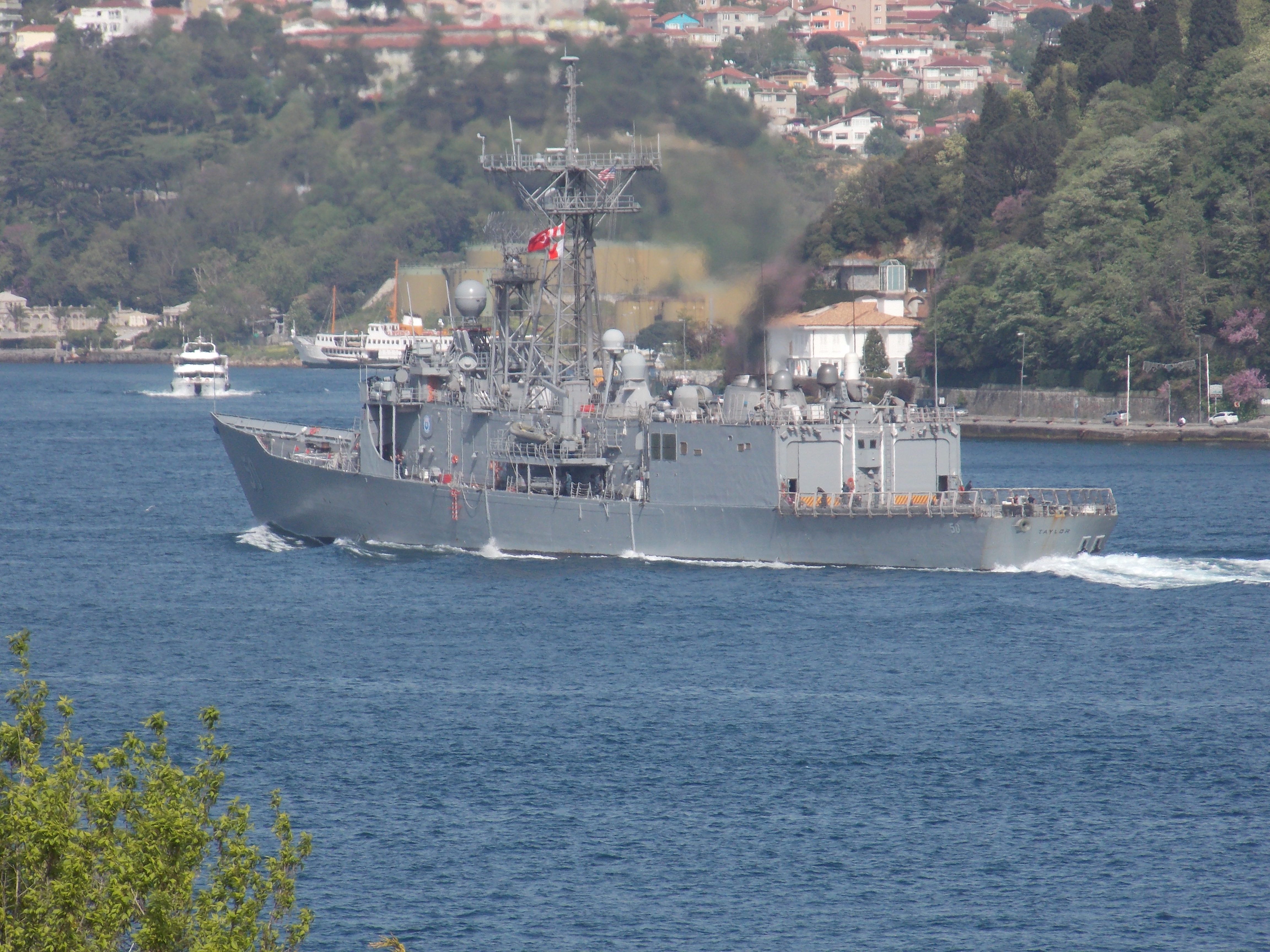
US navy frigate returns to the Black Sea


The US Navy frigate the USS Taylor has passed through the Dardanelles Strait, returning to the Black Sea after repairs and a few days after Nato said that it was increasing its presence on sea, air and land after Russia’s continuing interference in Ukraine.The Taylor was in the Black Sea area earlier, at the time of the Sochi Olympics in February 2014, when she ran aground in an incident that caused the captain his command.

Russian foreign minister Sergey Lavrov has accused the United States of violating the Montreux Convention which limits the number of vessels in the Black Sea. Lavrov said that the Taylor had remained in Black Sea waters for more than the 21-day limit allowed by the convention.Turkish foreign minister Ahmet Davutoglu said that his country would not allow the convention to be violated. He said that the Taylor had remained in the area past the time limit because of the accident.

Currently part of the US Sixth Fleet, the Taylor’s scheduled deployment includes supporting maritime security operations and theater security co-operation efforts, establishing and enhancing co-operation, and mutual training and interoperability with regional partner nations and Nato allies.The vessel, commissioned in 1984, is due for decommissioning in 2015 and has been named as one of four US frigates that were the subject of negotiations for sale to Taiwan.

USS Taylor Passed Through The Bosphorus


http://turkishnavy.net/2014/04/23/uss-taylor-passed-through-the-bosphorus/

Photo: Yörük Işık.

Photo: Yörük Işık.

Tuesday, April 22, 2014

U.S. Plans to Sell Mexico 18 Black Hawks to Tackle Drug Trade

Wikipedia


The Pentagon said Monday it has informed the US Congress that it plans to sell 18 Black Hawk helicopters to Mexico for $680 million.Lawmakers have 30 days as of April 17, when they were notified, to raise any objections. Otherwise, the contract will be concluded. The proposed deal — announced a few days before a visit to Mexico by US defense chief Chuck Hagel — is for 18 UH-60M Black Hawks with associated equipment, parts, training and logistical support, said the Defense Security Cooperation Agency (DSCA).”This proposed sale will contribute to the foreign policy and national security of the United States by helping to improve the security of a strategic partner,” added the agency, which oversees foreign arms sales.

A New Robotic System Turns Regular Navy Helicopters Into Unmanned Drones


The Autonomous Aerial Cargo/Utility System, or AACUS for short, is a set of sensors and software developed by Near Earth Autonomy for remotely piloting military helicopters.The system essentially turns a pre-existing conventional helicopter into an unmanned drone capable of being piloted and maneuvered via tablet. The value here is in safely dispatching supplies to troops in need and in evacuating wounded soldiers without risking the life of a pilot.

AACUS is dependent on a scanning laser rangefinder to detect obstacles and gauge distances. Its Lidar (remote sensing technology) unit scans forward in order to avoid obstacles while in flight, and it can angle directly downward to search for a safe landing area.The animation below shows actual data received by the AACUS sensors. The terrain is algorithmically sectioned off into areas that get a “grade” for landing quality. Red squares are “aborts” to be avoided. The green spots are identified as safe landing spots.


After a brief training session with the tablet software, Marines without flight experience can become functional drone pilots.


http://www.businessinsider.com.au/aacus-unmanned-helicopter-system-2014-4