Showing posts with label PLAN. Show all posts

Friday, October 23, 2015

September 2015 Sea Surface Warmest On Record

Arctic Sea Ice Extent Growth Seals Off Arctic Ocean


Arctic sea ice increased rapidly in October 2015, after reaching its annual minimum in September. As the image below shows, the growing sea ice extent has effectively sealed off the Arctic Ocean from the atmosphere, resulting in less evaporation and heat transfer from the ocean to the atmosphere.

The Naval Research Laboratory 30-days animation (up to October 22, with forecast added up to October 30) on the right shows that sea ice has grown in extent, adding plenty of very thin sea ice, while the existing ice has hardly increased its thickness.

The Buffer Has Gone

Thick sea ice used to extend meters below the sea surface in the Arctic, where it could consume massive amounts of ocean heat through melting this ice into water. As such, thick sea ice acted as a buffer. Over the years, Arctic sea ice thickness has declined most dramatically. This means that the buffer that used to consume massive amounts of ocean heat carried by sea currents into the Arctic Ocean, has now largely gone.

Latent heat loss, feedback #14 on the Feedbacks page
Cold Freshwater Lid on North Atlantic

Meanwhile, especially from 2012, huge amounts of freshwater have run off Greenland, with the accumulated freshwater now covering a huge part of the North Atlantic, acting as a lid that prevents ocean heat to evaporate from the North Atlantic.


Since it's freshwater that is now covering a large part of the surface of the North Atlantic, it will not easily sink in the very salty water that was already there. The water in the North Atlantic was very salty due to the high evaporation, which was in turn due to high temperatures and strong winds and currents. Freshwater tends to stay on top of more salty water, even though the temperature of the freshwater is low, which makes this water more dense. The result of this stratification is less evaporation in the North Atlantic, and less transfer of ocean heat to the atmosphere, and thus lower air temperatures than would have been the case without this colder surface water.

Cold freshwater lid on North Atlantic, feedback #28 on the Feedbacks page
The cold lid over the North Atlantic has meanwhile expanded. Greenland has been experiencing wild weather swings this month, with temperatures shifting from one extreme end of the scale to the other end. The image below shows temperature anomalies on October 17 (left panel), October 23 (center panel) and a forecast for October 30 (right panel). Temperatures are forecast to swing back to the extreme high end of the scale, pushing up temperature anomalies for the Arctic as a whole to as high as 2.37°C on October 30, 2015.

Wild weather swings causing methane releases, feedback #21 on the Feedbacks page
These wild weather swings over Greenland threaten to cause cracks in the ice, with methane hydrates in the ice becoming destabilized, resulting in releases of huge amounts of methane from hydrates and free gas into the atmosphere, as earlier discussed as feedback #21 on the Feedbacks page.

Strong winds have further contributed to extend the cold lid over the North Atlantic, while also making cold air flow from Greenland over the North Atlantic. This is illustrated by the image below, depicting the situation on October 23, 2015, with the left panel showing surface wind speed, while the right panel shows the resulting sea surface temperature anomalies. 


The video below shows surface wind speed forecasts in the Arctic from October 25 to November 1, 2015.


Ocean Temperature Rise

NOAA analysis shows that the global sea surface in September 2015 was the warmest on record, at 0.81°C (1.46°F) above the 20th century average of 16.2°C (61.1°F). On the Northern Hemisphere, the anomaly was 1.07°C (1.93°F).

[ click on image to enlarge ]
Of all the excess heat resulting from people's emissions, 93.4% goes into oceans. Accordingly, the temperature of oceans has risen substantially over the years and - without action - the situation only looks set to get worse.

The Threat

As ocean temperatures continue to rise, especially in the North Atlantic, the Gulf Stream will keep carrying ever warmer water from the North Atlantic into the Arctic Ocean. Without the buffer of thick sea ice to consume the increasing amount of ocean heat, the threat is that ocean heat will increasingly reach the seafloor and unleash huge methane eruptions from destabilizing clathrates. Such large methane eruptions will then warm the atmosphere at first in hotspots over the Arctic and eventually around the globe, while also causing huge temperature swings and extreme weather events, contributing to increasing depletion of fresh water and food supply, as further illustrated by the image below, from an earlier post.
[ click on image at original post to enlarge ]

October 2015 Sea Surface Temperature Update

The North Atlantic continues to be very warm. Sea surface temperature anomalies were as high as 7.9°C or 14.2°F at a location off the east coast of North America on October 22, 2015. Anomalies were 8.1°C or 14.5°F at that same spot on October 16, 2015.


Sea surface temperature anomalies were as high as 7.5°C or 13.6°F at a location near Svalbard on October 25, 2015. On October 9, 2015, sea surface temperatures were as high as 13.1°C or 55.6°F at that same location near Svalbard (marked by green circle on image below), an anomaly of 9.5°C or 17.2°F. These temperatures indicate that the water can be much warmer below the surface than at the surface, and that this warm water is transported by the Gulf Stream below the surface of the North Atlantic into the Arctic Ocean. The animation below switches between the above two dates and also shows that the cold freshwater lid on the North Atlantic has meanwhile extended further south.


In the Bering Strait, warm water also keeps flowing into the Arctic Ocean. At the location marked by the green circle on the image below, sea surface temperatures were as high as 7.3°C or 45.1°F on October 22, 2015, an anomaly of 5.7°C or 10.2°F.


Methane

The images below show high methane concentrations over the Arctic.


Above image shows methane levels at low altitude on October 22, 2015. Because of its height, there are no data at this altitude for Greenland. The image below shows methane concentrations at a higher altitude, with high methane levels showing up over Greenland on October 16, 2015.


Climate Plan

The situation is dire and calls for comprehensive and effective action, as discussed at the Climate Plan.

Malcolm Light comments

GLOBAL EXTINCTION IS NOW SIX YEARS CLOSER

The following comments refer to Figure 224 below. All historical floating ice appears to have been lost in the Arctic by September 2015 so we can assume that the 5+ year old ice pack has largely gone by this time. The 5+ year old ice pack was only predicted to melt back by 2021.7 consequently this year's volume of ice melting has occurred 6 years earlier than the previous prediction. The previous estimate of the final loss of 1 year Arctic floating ice from polynomial data was 2037.7 which now corrects to 2031.7, 16 years in the future.

Previous estimates of when the average atmospheric global temperature anomaly increase would reach 6°C was 2034.7, by which time massive global extinction would be proceeding. The new corrected time for this event is 2034.7 - 6 = 2028.7 which is 13 years in the future. During the major Permian Extinction event, which was caused by a massive methane build-up in the atmosphere, the mean surface atmospheric temperature increased by 5°C over 13 years. As the present mean global surface atmospheric temperature is already greater than 1°C hotter than the mean, we will be looking at at least a 6°C temperature increase by 2028 with its associated global extinction event. This is a frightening correlation between the new predicted 6°C average global surface atmospheric temperature rise and what is known to have occurred during the major Permian extinction event, both of which were caused by a massive buildup of methane in the atmosphere. We are clearly in for a very rough-hot ride in the next decade as the terminal global extinction event approaches.

Malcolm P.R. Light (Dr)
Earth Scientist
Figure 224. Arctic sea ice melt back times estimated from area, volume and thickness anomalies compared to various extinction zones defined by the global atmosphere temperature field. Credit: Malcolm Light. Click on image to enlarge.

Related

- Ocean Temperature Rise
http://arctic-news.blogspot.com/2014/10/ocean-temperature-rise.html

- Ocean Temperature Rise Continues

- Gulf Stream brings ever warmer water into Arctic Ocean
http://arctic-news.blogspot.com/2015/06/gulf-stream-brings-ever-warmer-water-into-arctic-ocean.html

- The Mechanism leading to Collapse of Civilization and Runaway Global Warming
http://arctic-news.blogspot.com/p/the-mechanism.html

- The Threat of Global Warming causing Near-Term Human Extinction
http://arctic-news.blogspot.com/p/threat.html

- Warming Arctic Ocean Seafloor Threatens To Cause Huge Methane Eruptions
http://arctic-news.blogspot.com/2015/09/warming-arctic-ocean-seafloor-threatens-to-cause-huge-methane-eruptions.html

- Climate Plan
http://arctic-news.blogspot.com/p/plan.html


NOAA analysis shows that the global sea surface in September 2015 was the warmest on record, at 0.81°C (1.46°F) above...
Posted by Sam Carana on Friday, October 23, 2015

Sunday, May 4, 2014

China, Russia Military Ties Deepen With Naval Drill in East China Sea


China announced that it plans to hold joint naval drills with Russia in the East China Sea later this month.“These drills are regular exercises held by China and Russia’s navies, and the purpose is to deepen practical cooperation between the two militaries, to raise the ability to jointly deal with maritime security threats,” China’s Defense Ministry said in a statement published on its website.Voice of America reports that the joint naval drills will be held in late May off the coast of Shanghai. This is significantly north of the Diaoyu/Senkaku Islands that have been the source of ongoing tensions between Japan and China in recent years. Russia also has an ongoing territorial dispute with Japan over the Kuril Islands located even further north off the far eastern coast of Russia.

Few details have been released about the scope of the naval drills at this time.Still, the announcement is not surprising, and is not likely aimed at Japan in particular. As China’s Defense Ministry noted, Russia and China have a history of holding joint naval drills, and their military ties have grown stronger in recent years. For example, last July, Moscow and Beijing held a massive naval drill with live firing exercises off the coast of the Russian city of Vladivostok. According to Chinese media reports at the time, the drill was the People’s Liberation Army’s largest ever with a foreign country.


Read More:

http://thediplomat.com/2014/05/china-russia-military-ties-deepen-with-naval-drill-in-east-china-sea/

Friday, May 2, 2014

PLA may build 3 more carriers amid territorial disputes: Kanwa


The People's Liberation Army (PLA) Navy may build three Liaoning-class aircraft carriers to prepare for a potential conflict with Japan in the Asia-Pacific region, according to the Canada-based Kanwa Defense Review operated by Andrei Chang, also known as Pinkov.Light aircraft carriers such as the Liaoning and Japan's Izumo have become vital for the PLA Navy and Japan Maritme Self-Defense Force amid territorial disputes between the two countries, the article said. It added that Japan may become an even greater threat to China if the country successfully introduces a Tarawa-class amphibious assault ship from the United States and deploys its F-35B fighters with vertical take-off and landing ability aboard the ship.

To face Japan in a potential combat situation, the PLA Navy needs to construct at least three aircraft carriers based on the Liaoning — which was refitted from the Soviet-era carrier Varyag purchased from Ukraine Kanwa said.Meanwhile, if Japan is unable to purchase the Tarawa-class amphibious assault ship, the Izumo alone can carry at least 24 F-38B fighters after the vessel's fuel supply facility is removed, while Tokyo will likely choose to purchase cheaper but older AV-8 fighters.

Japan's F-35B fighter is designed mostly for surface attack missions and it is thus unable to compete against China's J-15 carrier-based fighters. But neither China nor Japan is likely to deploy aircraft carriers against each other over a narrow battlefield like the disputed East China Sea, Kanwa said, adding that if the local conflict escalated into a full scale war, it would be up to the United States to decide whether or not to fight for Japan.

Imaginary video shows Japanese stealth aircraft soundly defeating the PLAN

All Japanese missiles hit but none of the PLAN missiles do.
Video shows missiles score direct hit on 2 PLAN aircraft carriers out of which one sinks.

Nice video to watch with kids.


Thursday, May 1, 2014

F-35 is Liaoning's worst nightmare, says Global Times


The US F-35 Joint Strike Fighter is capable of combating China's first aircraft carrier, the Liaoning, reports Huanqiu, the website of China's nationalistic Global Times tabloid.In a hypothetical aircraft carrier battle between China and the United States, the main fighter jets would include the United States' F-35C fifth-generation multirole fighter developed by Lockheed Martin and China's J-15 carrier-based jet developed by Shenyang Aircraft Corporation.

The F-35 is equipped with extremely powerful offensive capabilities for both land and sea combat, with a weapons load of eight tonnes and the capacity to carry four AIM20C and AIM-9X mid-range and short-range air-to-air missiles.In an attack on the Liaoning the F-35 could carry joint strike missiles developed in Norway, which have a range of 290 kilometers. The J-15, on the other hand, could carry two YJ8-3 anti-missiles with a range of only 180 km.

In terms of radar technology, the US has the clear upper hand with its AN/APG-81 AESA radar developed by Northrop Grumman, which has a thousand transceivers with the ability to simultaneously search for 23 moving targets, including 19 targets in just 2.4 seconds, after which it would turn to tracking mode.Even against China's J-20, the stealth, twin-engine fifth-generation fighter aircraft prototype being developed by Chengdu Aerospace Corporation, the F-35 would still be the first to detect its opponent due to its superior radar.

Observers are asking whether the Japan Air Self-Defense Force will make modifications to its F-35A jets to use the domestically developed AAM-4 and AAM-5 medium-range active radar-guided air-to-air missiles or if they will use US missiles given the differences in dimensions.
The problem for Japan is the cost of the F-35A, which could mean fewer aircraft if the price continues to rise. The price of the F-35A was US$111.6 million back in 2010, while the F-35B cost US$109.4 million and the F-35C was priced at US$142.9 million; since then the average price of one F-35 has risen to as high as US$228 million, according to some sources.


http://www.wantchinatimes.com/news-subclass-cnt.aspx?id=20140429000104&cid=1101&MainCatID=11

China to bring 4 ships to RIMPAC naval exercise


China plans to bring four ships to Hawaii this summer as its vessels participate in the world’s largest naval exercises for the first time.China is expected to bring the Peace Ark, a navy hospital ship, as well as an oiler, a frigate and a destroyer, said Lt. Lenaya Rotklein, a spokeswoman for the U.S. Third Fleet, which is organizing the Rim of the Pacific exercises.

The drills are scheduled to begin on June 26 and last through Aug. 1.The U.S. hosts the exercises, which are also known as RIMPAC, every other year. They began in 1971 and have since grown to become the world’s largest maritime exercises.Twenty-three countries are expected to participate this year, including Canada, India, Japan and South Korea.The Peace Ark will participate in medical exchanges with other participants, Rotklein said. The oiler, the frigate and the destroyer are expected to join a maritime interdiction operations task force.The scenario for the exercise involves four fictitious countries — one of which is an aggressor — in an island region, she said.Most of the drills will take place in and around the Hawaiian Islands. As in 2012, a small part of it will take place off Southern California, Rotklein said.

China sent military observers to watch the drills in 1998, but it has never sent ships before.Chinese and U.S. naval vessels have only rarely exercised together in the past. Last year, China sent a guided missile cruiser, a frigate and a supply ship to Hawaii for a search-and-rescue exercise with the U.S.The U.S. values such opportunities in part so the Navy and China’s fast-growing naval forces will learn to understand each other better and avert misunderstandings.Last December, a U.S. Navy cruiser, the USS Cowpens, nearly collided with a ship accompanying China’s sole aircraft carrier in international waters of the South China Sea. The U.S. Navy said the Cowpens maneuvered to avoid crashing into the Chinese ship, in the two nations’ most serious sea confrontation in years.

Earlier this month, the U.S., China and two dozen Asia-Pacific nations adopted an agreement to improve communication at sea to reduce the possibility of incidents like that one and misunderstandings that could lead to conflict in the heavily trafficked sea lanes surrounding China, Japan and Southeast Asia.


http://www.navytimes.com/article/20140429/NEWS08/304290074/China-bring-4-ships-RIMPAC-naval-exercise


Sunday, April 27, 2014

Power in numbers: China surpasses Japan with surface combat ships


China has surpassed Japan in the construction and purchasing of new surface combat vessels, according to an Apr. 25 article on the Canada-based Kanwa Defense Review operated by military analyst Andrei Chang, also known as Pinkov.China's surface combat vessels may not be as good as their Japanese counterparts in terms of quality, the article said, but the People's Liberation Army (PLA) Navy has a greater number of destroyers and frigates equipped with active electronically scanned array radar. The PLA Navy currently has six Type 052C guided-missile destroyers, each carrying up to 49 HQ9 air defense missiles. In addition, the vessel can fire YJ-62 anti-ship cruise missiles, which have a range of 280 kilometers.

The country has also completed the construction of two Type 052D destroyers based on the Type 052C, and the new vessel can carry 64 HQ9 air defense missiles. Four more Type 052Ds are under construction at the Dalian and Jiangnan shipyards.The PLA Navy will likely operate between 10-12 Type 052C and Type 052D destroyers by 2015, but China will still lag behind the United States and Japan in building quality vessels, according to Kanwa.

The Japan Maritime Self-Defense Force (JMSDF) currently has four Kongo-class and two Atago-class destroyers. Equipped with the Aegis Ballistic Missile Defense System and RIM-161 Standard Missile 3, all six destroyers are twice as powerful as their Chinese counterparts in intercepting enemy aircraft and missiles. The JMSDF destroyers are also better than the PLA Navy destroyers in anti-submarine, electronic and cyber warfare, the article said.Despite a disparity in quality, China has numerical superiority over Japan. The PLA Navy has 18 Type 054A frigates, while the JMSDF only has nine Murasame-class and five Takanami-class frigates.

Saturday, April 26, 2014

China splurging on military as U.S. pulls back


China’s navy commissioned 17 new warships last year, the most of any nation. In a little more than a decade, it’s expected to have three aircraft carriers, giving it more clout than ever in a region of contested seas and festering territorial disputes.

Those numbers testify to huge increases in defense spending that have endowed China with the largest military budget behind the United States and fueled an increasingly large and sophisticated defense industry. While Beijing still lags far behind the U.S. in both funding and technology, its spending boom is attracting new scrutiny at a time of severe cuts in U.S. defense budgets that have some questioning Washington’s commitments to its Asian allies, including some who have lingering disputes with China.

Beijing’s newfound military clout is one of many issues confronting President Barack Obama as he visits the region this week. Washington is faced with the daunting task of fulfilling its treaty obligations to allies such as Japan and the Philippines, while also maintaining cordial relation with key economic partner and rising regional power China.

China’s boosted defense spending this year grew 12.2 percent to $132 billion, continuing more than two decades of nearly unbroken double-digit percentage increases that have afforded Beijing the means to potentially alter the balance of power in the Asia-Pacific. Outside observers put China’s actual defense spending significantly higher, although estimates vary widely.

Increases in spending signal “strength and resolve to China’s neighbors,” requiring other countries to pay close attention to where Beijing is assigning its resources, said China defense expert Abraham Denmark, vice president for political and security affairs at the U.S-based National Bureau of Asian Research.

At the same time, the U.S. military is seeking to redirect resources to the Asia-Pacific as it draws down its defense commitment in Afghanistan, although officers warn that budget cuts could potentially threaten plans to base 60 percent of U.S. naval assets to the region. Chief of Naval Operations Adm. Jonathan Greenert recently warned that U.S. capabilities to project power “would not stay ahead” of those of potential adversaries, given the fiscal restraints.

Meanwhile, China’s navy is rapidly developing into a force to contend with the U.S., long the dominant military player in the Asia-Pacific region.

China commissioned its first aircraft carrier — a refurbished Ukrainian hull — in 2012, and another two indigenous carriers are expected to enter service by 2025, significantly increasing Beijing’s ability to project power into the South China Sea that it claims virtually in its entirety.Analysts say China will have as many as 78 submarines by 2020, part of an expansion that has seen it leap past the U.S. and Russia in numbers of warships delivered annually, according to experts and available figures.


http://www.navytimes.com/article/20140424/NEWS08/304240036/China-splurging-military-U-S-pulls-back


Wednesday, April 23, 2014

Maritime Cooperation 2014 - Qingdao, China

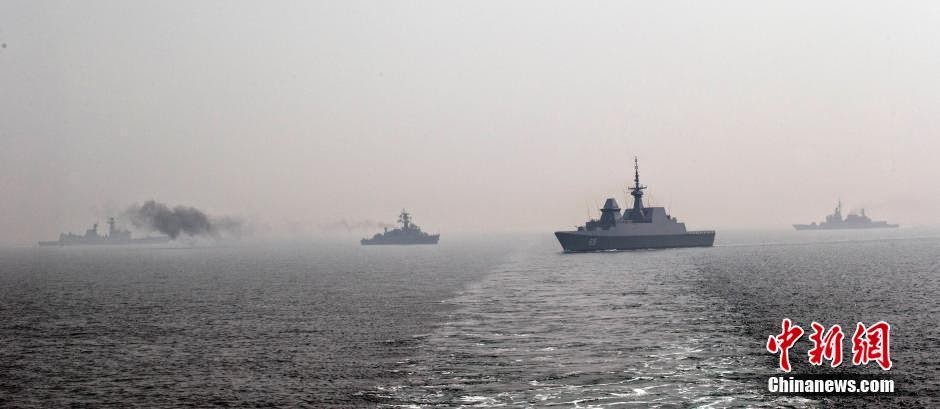
Marking the 65th anniversary of the founding of the People's Liberation Army Navy, navies from eight Asian nations — Pakistan, Indonesia, Singapore, India, Malaysia, Bangladesh and Brunei — were invited to Qingdao in eastern China to take part in the Maritime Cooperation 2014 naval exercise on Apr. 23. Some 19 warships and seven helicopters took part in the exercise, aimed at testing the ability of the Chinese navy and its partners in rescue and anti-piracy operations.


See Below : Only Abu Bakar frigate of Bangladesh Navy (F15) and Singapore frigate
RSS Formidable (68) and the unnamed Chinese ship captured in the photo stream.


19 Warships stage War Games near Qingdao, China