Showing posts with label South Korean Weapons. Show all posts

Thursday, May 1, 2014

South Korea to upgrade missile defense


South Korea on Monday approved a plan to purchase scores of Patriot Advanced Capability-3 missiles from the U.S. for deployment from 2016-2020, the state defense acquisition agency said.During a top defense decision-making meeting presided over by Defense Minister Kim Kwan-jin, Seoul endorsed the plan that also includes upgrading the current missile interception system from 2014 through 2020. The upgrading work includes enhancing radars, launchers and control programs.

The government has set aside a budget of between 1.3 trillion won ($1.25 billion) and 1.4 trillion won for the plan aimed at countering North Korea’s persistent missile threats. Seoul plans to purchase the hit-to-kill PAC-3 missiles from the U.S. through a government-to-government foreign military sale method, while the project to upgrade the interception system will be carried out through a competition, which would invite European firms such as MBDA of Germany.

Seoul has been pushing to upgrade its interception system and purchase advanced missile interceptors as it seeks to build its own independent missile defense system, called the Korea Air and Missile Defense.The KAMD is a low-tier, multiple-interception program, which destroys incoming missiles at an altitude of 40-50 km with multiple interceptors. Currently, Seoul has PAC-2 missiles with fragmentation-type warheads, less lethal than the PAC-3, which employs “hit-to-kill” technology.


http://www.koreaherald.com/view.php?ud=20140428001318


Friday, April 11, 2014

South Korea shows interest to purchase Israeli RPS-42 tactical air surveillance radar

The RPS-42 is a member of RADA's Multi-Mission Hemispheric Radar (MHR) family, enabling advanced protection solutions.


South Korea is pushing to buy about 10 low-altitude radars from Israel to better detect small unmanned aerial vehicles (UAVs) and thereby counter threats posed by North Korean drones, military officials said Wednesday. The military has been hastily preparing measures to step up its surveillance capability, in the wake of the discovery of three small UAVs near the tensely guarded border with North Korea in recent weeks.

The suspected North Korean drones equipped with cameras, which contained photos of Seoul's presidential office and military installations near the border, revealed holes in South Korea's air security.The South currently operates TPS-840K missile control and ground surveillance radars, which are limited in detecting small aircraft such as the suspected North Korean drones that were discovered only after they've fallen on the ground.

To fill the holes in air security, the military has hurriedly assigned 200 billion won (US$191 million) to buy 10 low-altitude radars and other surveillance equipment this year to deploy them in major posts and front-line troops, a government official said."The government decided to transfer some budget from another acquisition program to purchase the low-altitude surveillance radars capable of detecting small UAVs as soon as possible," the official said, asking for anonymity. "The program is aimed at finalizing a contract within this year to be able to deploy them by next year."

A team of military and acquisition officials has been dispatched to Israel to visit Rada Electronic Industries, which produces RPS-42 Tactical Air Surveillance Radar System, a potential candidate.The RPS-42 Tactical Air Surveillance Radar System is optimized to detect, classify and track all types of aerial objects at altitudes from 30ft to 30,000ft within a radius of up to 30km. Among these objects are fighters, helicopters, UAVs, transport aircraft, and others.

The military is also pushing to supplement its existing surveillance equipment, such as the Thermal Observation Device (TOD) and multipurpose telescopes deployed near the border.A laser weapon system that can effectively destroy an approaching UAV is considered for integration with the low-altitude surveillance radar. Germany's Rheinmetall Defence is a potential provider.A multipurpose anti-air gun, which integrates the 30 mm self-propelled gun K-30 and Chiron anti-air missile, can be placed in major posts to supplement the existing air defense system, which includes Vulcan guns.

Local media criticized the military's hastily prepared measures to step up its surveillance capability as they only came after revelations that the drones flew undetected across the border despite the South having known about the North's development of the UAVs as asymmetric weapons.

Saturday, April 5, 2014

S. Korea test-fires ballistic missile capable of striking North Korea


South Korea has successfully test-fired an extended range ballistic missile and will develop a longer range missile capable of striking all parts of North Korea, Seoul's defense ministry said Friday.

South Korea currently operates Hyunmoo ballistic missiles with a range of 300 kilometers, and has been developing longer range missiles to beef up its defense against Pyongyang under a new missile deal with the United States.The guidelines revised in October 2012 allow Seoul to extend the maximum range of its ballistic missiles from 300 km to 800 km. It limits the maximum payload to 500 kg for 800-km range missiles, while allowing heavier payloads for missiles with shorter ranges.

"The missile development is part of follow-up measures after South Korea and the United States revised the missile guidelines," ministry spokesman Kim Min-seok said in a briefing. "We are now developing 500-km ballistic missiles and plan to make 800-km missiles in the future." He didn't elaborate on the deployment schedule.The state-funded Agency for Defense Development on March 23 tested a ballistic missile with a range of 500 km and a payload of 1 ton at a firing range in Taean, South Chungcheong Province, and it hit the intended target, a senior official said.

Following the deployment of the 500-km range missile next year, the military plans to develop an 800-km missile with a payload of 500 kg and test-fire it the same year, the official said.

http://www.globalpost.com/dispatch/news/yonhap-news-agency/140404/s-korea-test-fires-ballistic-missile-capable-striking-north

Friday, March 28, 2014

Republic Of Korea Air Force Accepts First C-130J Super Hercules

Photo Lockheed Martin


The Republic of Korea ushered in a new era in air mobility today with the delivery of the country’s first two C-130J Super Hercules aircraft at the Lockheed Martin facility here. With today’s delivery, South Korea became the 14th country to fly the proven C-130J.

South Korea’s new Super Hercules will be operated by Republic of Korea Air Force (ROKAF) aircrews, which currently operate a fleet of C-130H legacy aircraft.
“For almost three decades, Republic of Korea Air Force crews have relied on C-130s to support humanitarian and peacekeeping missions in the Pacific Rim region. The arrival of South Korea’s new Super Hercules fleet ensures that these critical missions not only will continue, but extend for many more decades the added capabilities only the C-130J can provide,” said George Shultz, vice president and general manager, C-130 Programs. “Lockheed Martin values its longtime partnership with South Korea and we are honored to welcome it to the Super Hercules family.”

The ROKAF’s new Super Hercules is the longer fuselage or “stretched” combat delivery variant. Lockheed Martin is also contracted to provide a two-year support program to the ROKAF, including C-130J aircrew and maintenance training.

Sixteen countries have chosen the C-130J Super Hercules to meet their air mobility needs. With more than 1 million flight hours, the C-130J is the standard by which all other airlift is measured in terms of availability, flexibility and reliability. Over the past decade, C-130Js have been deployed in two combat theaters where they operate at a very high tempo efficiently and reliably.

In non-combat — but equally harsh environments — C-130Js are often the first to support humanitarian missions such as search and rescue, aerial firefighting in the U.S., and delivering relief supplies after earthquakes, hurricanes, typhoons and tsunamis around the world.
Headquartered in Bethesda, Md., Lockheed Martin is a global security and aerospace company that employs approximately 115,000 people worldwide and is principally engaged in the research, design, development, manufacture, integration and sustainment of advanced technology systems, products and services. The Corporation’s net sales for 2013 were $45.4 billion.

Thursday, March 13, 2014

South Korea to upgrade its Patriot missile system


South Korea will buy upgraded Patriot surface-to-air missiles next year to improve its defenses against North Korea, officials said Wednesday.South Korea currently has 48 PAC-2 missiles from Germany, and plans to add PAC-3 missiles, which have improved anti-ballistic missile capability, to its arsenal next year, the Yonhap News Agency reported.

The country will also upgrade its fire control system to make it capable of firing both types of missiles.The plan was approved by Defense Minister Kim Kwan-jin in an effort to open bidding in June and have a contract finalized by December.

"Once the Patriot missile system is upgraded, it will be able to directly hit incoming missiles to reduce damage on the ground," Baek Yoon-hyung, spokesman for the Defense Acquisition Program Administration, said in a briefing Wednesday.

Wednesday, January 15, 2014

Eighteen F-4E Phantom aircraft stage Elephant Walk in South Korea


18 F-4E belonging to the 17th Fighter Wing based at Cheongju airbase, about 100 km to the southeast of Seoul, taxing along the runway in rows of three Phantoms.

The reason is that these kind of training activities, with several planes taxiing in close sequence or formation along the runway, is conduct with a dual purpose: first, to test squadrons readiness to war time operations; second, as a show of force, to impress the threatening neighbour North Korea.

Image credit: ROKAF

Monday, January 6, 2014

South Korean Choppers to Be Armed with Israeli Missiles


More Israeli-made Spike missiles with the maximum range of 25 km will be installed in maritime helicopters ready for deployment next year.Several Spike missiles are already installed on vehicles defending the northwesternmost islands.But the new lot will be mounted on Wildcat maritime choppers to be purchased over the next two years, an official with the Defense Acquisition Program Administration said Friday. "We've recently struck a deal with the Israeli manufacturer of the missile."

The Spike missile is allegedly capable of hitting a window-size target 25 km away guided by infrared. An officer said the missile can hit the North's coastal artillery as well as its high-speed boats or hovercraft if they launch surprise landings on South Korean territory.A total of eight Wildcat helicopters will be procured, each of which can carry four Spike missiles. The missiles cost about W300 million (US$1=W1,056) each, approximately 100 times the price of a shell for the K-9 self-propelled howitzer. 

Cheongung – a New MR-SAM for the South Korean Multi-Tier Defense System


Missiles deployed by North Korea are covering the entire area of the South, Pyongyang has deployed more than 600 short-range Scud missiles north of the Demilitarized Zone (DMZ), with a range of 320 to 500 kilometers. In addition, 200 Rodong missiles positioned inland have a range of 1,300 kilometers, reaching every point in the South. North Korean Intermediate range ballistic missiles can also reach Russia, China, Japan and Alaska.

Until recently Seoul relied primarily on the U.S. air defense umbrella, comprising Raytheon’s latest version MIM-23 Hawk XXI and ex-German MIM-104 Patriot PAC-2 missiles. Air and missile defense is augmented by the Navy’s AEGIS cruisers and destroyers, providing ad-hoc anti-missile defense.

To defend against North Korean missiles and rocket attacks the Republic of Korea is eying a three-tier aerial and missile defense system to integrate radars, missile interceptors of different types through a unified battle management system.


Seoul principal air defense layer operates six batteries of Patriot PAC-2 GEM/T missiles along with 24 Hawk XXI batteries. These assets are more capable to defend against aircraft than hit ballistic missiles. Two missile interceptor/air defense programs currently underway in Russia will be transferred for production in Korea, one covering extended range and high altitude, and another handling the middle-tier zone.

The first is the medium-range air defense system known as KM-SAM, developed in Russia by the Almaz Design Bureau, in association with an industry team from Korea lead by Samsung Thales. This team included missile builder LIG Nex1 and platform manufacturer Doosan DST. Further localization and industrialization were done in South Korea, making the new weapon system an indigenous program.
The new SAM called ‘Cheongung’ (Iron Hawk) can intercept targets at altitude up to 15 km and at a range of about 40 km.

A Cheongung battery comprises a fire control center, a multi-function radar and up to eight fire units, each carrying eight missiles in ready to launch configuration. It is designed to engage multiple targets simultaneously while tracking (hundred?) additional targets. The key for this capability are the compact multi-function radar developed by Thales-Samsung. Target data and intercept commands are transferred to the missile just prior to firing, with mid-course updates relayed in flight. The vertically launched missile is designed for high maneuverability withstanding loads of up to 50g. It weighs 400 kg, and uses INS guidance with midcourse updates, with active-homing RF seeker for terminal guidance. The multi-function radar is a 3D plannar active array system operating in the X band, it rotates at a rate of 40 rpm and covers up to 80 degrees in elevation.

Thursday, January 2, 2014

South Korea to Field Hybrid Version of the BiHO VSHORAD Vehicle in 2015


South Korea’s Defense Acquisition Program Administration (DAPA) announced Friday, December 27, 2013, that it has completed development of a hybrid variant of the self propelled air defense gun carrier K30 Bi-Ho (flying tiger in Korean) integrated with indigenously developed Shingung guided missiles. Both elements are based on indigenous technology.

The new hybrid system uses the vehicle’s target acquisition systems and Shingung surface-to-air missile to extend the system’s effective range from less than 3 km (guns only) to 7 km (missiles). As a ‘Very Short Range Air Defense System’ (VSHORAD), the hybrid Bi-HO will be able to effectively engage targets flying at very low altitude, such as helicopters and unmanned aerial vehicles (UAV). The system mounts two missile pods, each containing two missiles. Each pod can engage a different target, DAPA said. Over 300 K30 have been deployed with the Korean Army since 1999. According to the agency the hyprid variant entered development in 2010 and is expected to enter production in 2014 and be ready for fielding as new systems or an upgrade by 2015.

K30 Bi-HO integrates specific modules from a number of local manufacturers, including Doosan Defense Systems & Technology contributing the K200 armored personnel carrier chassis and and system integration, LIG Nex1 delivering the TPS-830K low-level target acquisition radar and Shingung missiles. Samsung Thales is providing the EO sensors comprising the FLIR system and laser rangefinder acting as a secondary target acquisition system, supplementing the radar to provide a passive target acquisition mode, where the air defense system remains passive until the missile is launched.

The modification includes mounting two Shingung missile pods on each side of the turret, to accomodate the heavier load the turret drive and power supply are uprated, and modifications to the existing fire control system are installed to handle target acquisition for the ‘fire and forget’ Shingung missile.


Tuesday, November 26, 2013

Navy patrol boat under construction sinks at shipyard


A moored Navy guided missile patrol boat under construction sank at a shipyard due to strong winds, the shipbuilder said Monday.

Sources said the 430-ton Gumdoksuri Class patrol killer guided missile (PKG) boat started sinking at around 3 a.m. as it was pounded by strong winds and waves. The boat, armed with 76 millimeter guns, was one of 24 being built to replace smaller Chamsuri Class patrol boats serving in the Navy.

The name of the shipyard on the southern coast was not revealed, although the builder confirmed that roughly 60 percent of the work, including the engines, were on board at the time of the accident.

Thursday, October 10, 2013

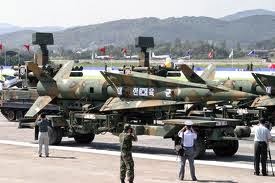
South Korea displayed for the first time its new Hyunmu-3 cruise missile at military parade

https://blogger.googleusercontent.com/img/b/R29vZ2xl/AVvXsEgAG5NIYcybJ-NJD6gZzZ3MNet2HrcNvnfhudliqIKnHNq9k46_aa-Q152F3ZvpeX3gwhbE6p2-x9b1-i1Al3PGLzozpZaVNu6eGs3cqKXObvU3Fb7nRVNDo8jq5vgtBF5pN5tB74YfOa0/s1600/Hyunmu-3_cruise_missile_South_Korea_Korean_army_defense_industry_military_technology_640_001.jpg

South Korea displayed its new longest-range missile Hyunmu-3 capable of striking all of North Korea and other sophisticated weapons at a massive military ceremony Tuesday, October 1, 2013, a display of force meant to show Pyongyang that any provocation would be met with strong retaliation.

Monday, May 27, 2013

South Korea plans to purchase US weapons worth $1b


Seoul has notified Washington of its intention to purchase weapons systems worth US$800 million (S$1 billion) to be mounted on its new fleet of warplanes should a US fighter be picked for its 8.3-trillion-won ($7.4 billion) acquisition project.

The Defence Security Cooperation Agency, which handles Washington's foreign military sales, revealed Seoul's request to buy high-tech arms such as Advanced Medium-Range Air-to-Air Missiles, GBU-12 laser-guided bombs and GBU-39 bunker busters.
Last month, Seoul made a separate request to purchase Lockheed Martin's F-35 stealth fighter or Boeing's F-15 Silent Eagle.

The Eurofighter Typhoon of the European Aeronautic Defence and Space Company is another candidate in the competition, through which Seoul seeks to purchase 60 jets to replace its aging F-4 and F-5 jets. The winner is expected to be announced next month.
Observers said the US products would be at an advantage in the contest given Seoul considers interoperability with US forces and alliance-related factors. But EADS has made attractive offers, such as investing $2 billion in Korea's project to develop indigenous fighters.

Friday, January 18, 2013

Republic of Korea Navy commissions First of Class "Incheon" FFX I Frigate

Republic of Korea Navy commissioned on 17 January 2013 the first of its next next generation FFX I class Frigate. The ship was by Hyundai Heavy Industry and is expected to replace the aging fleet of Pohang class corvettes and Ulsan class frigates, and take over multi-role operations such as coast patrol or anti-submarine warfare.


The class will be built in several batches. Six vessels will be built as Batch I (similar to head of class Incheon), eight Frigates will be built as Batch II by Daewoo Shipbuilding & Marine Engineering, and Batch III is also planned for the future.

Batch I vessels are reported to displace 2,500 tons with a length of 114 meters and a beam of 14 meters. The main gun is 127mm similar type to those used by the US Navy. For defense, the Incheon is fitted with a RIM-116 RAM launcher as well as a Phalanx CIWS. The class is also fitted with four SSM-700K Hae Sung I anti-ship missiles.

It is expected that Batch II vessels will receive VLS cells for long range SAMs and the locally built Hyunmoo-3 land attack cruise missile. No design specifics have been released yet however, regarding Batch II vessels.

Wednesday, June 27, 2012

Korea Aerospace Industries - T 50 aircraft


The T-50 was developed by Korea Aerospace Industries, Ltd., with cooperation and global marketing support from Lockheed Martin. Both firms were aware that many training aircraft fleets are aging, even as higher-performance fighters demand trainer aircraft that can keep up. The Korean government needed a fleet of trainers, and saw an opportunity to give their aerospace sector a strong boost in the process. Total investment in the T-50’s RDT&E program amounted to more than $2 billion: 70% from the Korean government, 17% from KAI, and 13% from Lockheed Martin.

With a length of 43 feet and a wingspan of 30 feet, the 2-seat T-50 is about 4 feet shorter than the F-16; overall, it’s only about 80% of the F-16’s size. The relative size of the control surfaces and tails are larger, however, to improve handling characteristics at lower speeds and make the aircraft easier to land. Larger landing gear is also fitted, to absorb harder landings, which is to be expected from student pilots. Its form’s resemblances to Lockheed Martin’s F-16 are suggestive, and include the blended mid-set wing, complete with leading-edge root extensions and rear ‘shelf’ fairings ending in F-16-style split airbrakes.


The air intake layout on the sides is somewhat similar to the F/A-18 Hornet or Northrop’s excellent but ill-fated F-20A Tigershark, and the aircraft is powered by the same engine: GE’s popular, reliable and fuel-efficient F404, with slight improvements over the F404-GE-402 to enhance single-engine redundancy and reliability.

The T-50 trainer carries a basic navigation / attack system, which gives it some multi-role capability. The aircraft can carry Sidewinder missiles on the wingtips, as well as fuel, rockets, or qualified bombs on its 5 underwing and center pylons. the center pylon and 2 inner underwing pylons are “wet,” and can accommodate 150 gallon fuel drop tanks.

The T-50 family’s empty weight is 14,000 pounds, and maximum takeoff gross weight is 29,700 pounds; the F404-GE-102 engine produces 17,700 pounds of thrust. Maximum rate of climb is 39,000 feet per minute; and the maximum speed is Mach 1.5. Service ceiling is 48,500 feet, the design load factor is 8gs, and the trainer airframe is designed for up to 10,000-hour service life

Monday, April 25, 2011

Photos of South Korean Aegis-equipped destroyer


US Navy's Adm. Roughead with his South Korean counterpart. What a great leader Adm. Roughead...I am a great fan of his