Showing posts with label Indian Army. Show all posts
Showing posts with label Indian Army. Show all posts
Saturday, April 26, 2014

Thursday, April 24, 2014
Akash Missile Fails to Destroy PTA Target


Misfortune struck the Akash missile project once again during a user associate trial from the Integrated Test Range (ITR) off the Odisha coast on Wednesday. The missile, test-fired by the Indian Air Force (IAF) personnel, reportedly failed to destroy the target.After twin successes in February, this sophisticated surface-to-air nuclear capable missile this time missed the ‘missed-distance’ proximity. It was the missile’s first trial of the three-trial series.
Defence sources said the missile was launched from the launching complex-III of the ITR at Chandipur-on-sea at about 2.43 pm. Prior to firing of the missile, a pilot-less target aircraft (PTA) was flown from the launching complex-II at about 2.30 pm.“The missile was to destroy the PTA at an altitude of nearly 2 km as per the pre-designated coordination. But the mission failed as the weapon could not destroy the target.
Though it attained the desired altitude, it failed to pass through missed-distance proximity,” said an official from the launching complex.The official said generally the missile does not directly hit the target, it passes through the missed-distance proximity, which may be 10 metres, 20 metres or 100 metres as per the coordination, causing auto-detonation of the proximity fuse in the target. “This time the missile passed away from the proximity area,” he informed.
Two more rounds of the tests have been planned to be carried out on Friday. “The defence scientists are working to fix the problem and hopefully the missile will be ready for test. The DRDO is providing all logistic supports for the trials,” the official added.On May 28 and May 30, 2012, the missile had failed to take off from the launch pad at the ITR. Two trials of the missile were planned back-to-back within a gap of one minute to gauge the flight consistency and effectiveness of the weapon system.Akash is a short-range anti-aircraft missile and can destroy targets 25 km away. The 5.8-metre sleek missile weighs around 720 kg and can carry a warhead of 50 kg. The missile is crucial to India’s air defence programme as it will be used to counter ballistic and cruise missiles, enemy aircraft and air-to-surface missiles.
This weapon can handle multiple targets with the help of a digitally coded command and guidance system. It is fuelled by solid propellants.The Akash missile system which is similar to the American Patriot air-to-surface missile system can track 64 targets simultaneously through its inbuilt sophisticated radar and fire 12 missiles at a time.
Sunday, April 20, 2014
75 percent Indians have full faith in Indian Military Establishment - Brookings Survey
2/3rds Indians believe in the military and 70-80 % are dissatisfied with the current Indian Berlusconi controlled political system.
Wednesday, April 16, 2014

Wednesday, April 9, 2014
India test fires Brahmos supersonic cruise missile

India’s armed forces on Monday carried out another successful test of BrahMos supersonic cruise missile.“The launch was carried out at the Pokhran range in the State of Rajasthan in the northwest of India at 13:00, local time to the maximum range of 290 kilometres,” he said. The missile that had been adopted by the country’s armed forces in 2007 was launched from a mobile launcher, in service in two Indian regiments. One more launcher of this type is to be delivered soon to another regiment of the Indian army.
The Russian-Indian JV BrahMos Aerospace at the Defexpo-2014 Land, Naval and Internal Homeland Security Systems Exhibition that was held in New Delhi in February for the first time presented a full-scale mock-up of its new BrahMos-M missile, a smaller version of the supersonic BrahMos cruise missile.The missile length is expected to be six metres, and diameter is 50 cm. It will be able to fly 3.5 times faster than sound and carry a warhead of 200 to 300 kilograms to a maximum range of 290 kilometres. The BrahMos missiles that have been tested as of today are two-stage cruise missiles with the length of 10 metres and diameter of 70 cm.
In March 2013, India also for the first time had tested a sub-launched version of the BrahMos supersonic cruise missile, and by the end of the current year intends to test an air-launched version of the missile from the Sukhoi Su-30MKI fighter.
Thursday, April 3, 2014
Media: India will purchase 66 000 Russian tank ammunition "Mango"

http://itar-tass.com/politika/1087580
India has signed an agreement with Russia on the purchase of her 66,000 armor-piercing ammunition "Mango" for tank guns of 125 mm caliber, which are equipped with T-90 tanks. It is reported by the news agency Press Trust of India.
The cost of the agreement is estimated at 26 billion rupees (419 million dollars). Previously it was necessary, in accordance with procedures approved by the Committee for Security Cabinet, Government of India.
The agreement also provides for the subsequent production of these weapons under license in India. They will control the arms factories (Ordnance Factory Board).
Need to purchase the Ministry of Defence explained the acute shortage of tank ammunition from the Indian armed forces.
Sunday, March 30, 2014
Singapore and Indian Armies Conduct Tenth Bilateral Armour Exercise
Source:Singapore MinDef
http://www.mindef.gov.sg/imindef/press_room/official_releases/nr/2014/mar/28mar14_nr.html#.UzjlD_mSySo


The Singapore Army and the Indian Army are conducting Exercise Bold Kurukshetra, a bilateral armour exercise from 1 to 31 March 2014. This year's exercise is the tenth in its series involving 690 soldiers from the Singapore Army and Indian Army. As part of the exercise, the two armies executed integrated manoeuvres and engaged in joint planning and training.
A highlight of this year's exercise was the integrated live-firing by armoured fighting vehicles from both armies. Commenting on the success of the exercise, Commanding Officer of the 42nd Battalion of the Singapore Armoured Regiment Lieutenant Colonel Ng Wei How said, "the rich exchanges and joint training with the Indian Army in Exercise Bold Kurukshetra 2014 have enhanced bilateral coordination and interoperability between the two armies."
Exercise Bold Kurukshetra is conducted under the ambit of the Bilateral Agreement for Joint Army Training and Exercises between the Singapore and Indian armies. This exercise underscores the warm defence relationship between both countries. Both defence establishments also interact regularly through high-level visits, policy dialogues, courses, seminars and other professional exchanges.
http://www.mindef.gov.sg/imindef/press_room/official_releases/nr/2014/mar/28mar14_nr.html#.UzjlD_mSySo
The Singapore Army and the Indian Army are conducting Exercise Bold Kurukshetra, a bilateral armour exercise from 1 to 31 March 2014. This year's exercise is the tenth in its series involving 690 soldiers from the Singapore Army and Indian Army. As part of the exercise, the two armies executed integrated manoeuvres and engaged in joint planning and training.
A highlight of this year's exercise was the integrated live-firing by armoured fighting vehicles from both armies. Commenting on the success of the exercise, Commanding Officer of the 42nd Battalion of the Singapore Armoured Regiment Lieutenant Colonel Ng Wei How said, "the rich exchanges and joint training with the Indian Army in Exercise Bold Kurukshetra 2014 have enhanced bilateral coordination and interoperability between the two armies."
Exercise Bold Kurukshetra is conducted under the ambit of the Bilateral Agreement for Joint Army Training and Exercises between the Singapore and Indian armies. This exercise underscores the warm defence relationship between both countries. Both defence establishments also interact regularly through high-level visits, policy dialogues, courses, seminars and other professional exchanges.
Friday, March 28, 2014
India successfully tests n-capable Prithvi-II missile Again

India Friday successfully test-fired its nuclear-capable Prithvi-II surface-to-surface missile from a military base in Odisha, a senior official said.The indigenously-developed ballistic missile with a maximum range of 350 km was fired from the Integrated Test Range at Chandipur in Balasore district, about 230 km from Bhubaneswar.
"It was a perfect launch. It met all mission objectives," test range Director M.V.K.V. Prasad told IANS.
The Strategic Forces Command (SFC) of the Indian Army conducted the test as part of a regular training exercise, he said.Prithvi is India's first indigenously-built ballistic missile. It is one of the five missiles being developed under the country's Integrated Guided Missile Development Programme.
The battlefield missile, with flight duration of 483 seconds and a peak altitude of 43.5 km, can carry a 500-kg warhead.The missile has features to deceive anti-ballistic missiles and uses an advanced inertial guidance system with manoeuvring capabilities and reaches its target within a few metres of accuracy.
It has a higher lethal effect compared to equivalent missiles in the world. Scientists say the accuracy has already been demonstrated in the past in the development flight trials.
Monday, March 24, 2014
Arjun Mark II Tank induction into the Indian Army could get delayed beyond 2016
The induction of Arjun MK II main battle tank into the Indian Army by 2016 may get delayed further due to the LAHAT Anti-Tank Guided Missile (ATGM).The Israelis -IAI- who customised the LAHAT Anti-Tank Guided Missile (ATGM) for firing from the 120 mm main gun of the Mark II variant, have gone back to the drawing boards for making the LAHAT to confirm to some Indian Army requirements.
LAHAT was originally developed 1992 by Israeli Aerospace Industries (IAI) for firing from their own Merkava MBT. With a diametre of about 105 mm, the anti-tank can be independently targeted or targeted through laser designation. The latter means an alternative platform can illuminate the target with the anti-tank guided missile (ATGM) homing in on the laser spot.
The range of the LAHAT missile pay-load is about three-and-a-half kilometres on the plains and about two-and-a-half kilometres in the deserts.
Tuesday, March 18, 2014
New Indian-made 155mm artillery howitzer Dhanush ready for use by Indian army end of this year.
After trials, India's indigenous artillery gun 'Dhanush' would be ready for use by the Army by the end of this year.Ordnance Factory Board (OFB) chairman M C Bansal today said the winter trials of the 'desi' howitzers were successfully completed in Sikkim and after the summer trials to be held in the deserts of Rajasthan in the next few months, it would be ready for use.
"We will add another laurel to the country by producing them with indigenous technology," he said. After the extensive trials, 'Dhanush' would be produced in bulk in the Gun Carriage Factory in Jabalpur and the Army has placed an initial order of 114 such guns.
An improved and indigenous version of the Swedish Bofors, 'Dhanush' is a 155mm and 45 calibre gun. While the original Bofors gun has a maximum effective range of 27 km, 'Dhanush' can fire a salvo up to 38 km in the plains. With the Defence Ministry focusing on indigenous technology, OFB had also decided to increase production capacity for making 5000 rockets for the Pinaka multi-barrel weapons system.
Sunday, March 2, 2014
India's Arjun MBT Mk II gears up for final leg of user trials
Defence scientists of Avadi (near Chennai) Combat Vehicle Research Development Establishment (CVRDE) are all set to take India's Arjun Main Battle Tank (MBT) Mk II for the concluding phases of user trials.
During the fourth phase of trial, the tank will have to be tested for obstacle crossing and medium fording (water) capabilities. "The concluding phases of the user trials will begin in May 2014.

Sunday, January 26, 2014
India unveils new local-made Arjun Mk-II main battle tank at the Republic Day Military Parade 2014
The Arjun Mk.II MBT (Main Battle Tank) was unveiled for the first time to the public at India's 65th Republic Day Military Parade, January 26, 2014. Thle latest version of Arjun MBT is aimed at exemplifying DRDO’s strength in the area of defence technology – design and development, leading to the production of state of the art weapon systems for India’s armed forces.

Saturday, December 21, 2013
Despite Delay, Indian Buy of Howitzers Remains on Track.

Indian Govt says date of signing 31st March 2014?
The Indian government has announced that the purchase of 145 ultra light howitzer artillery guns from the US is not being withheld, despite a three-year delay since clearance was granted to buy the guns from the US subsidiary of BAE Systems.
Anonymous complaints to the Defence Ministry regarding the process have delayed finalizing the contract, officials said.In August, Indian Defence Minister A.K. Antony told the Indian Parliament, “Various anonymous complaints regarding alleged irregularities in the procurement of ultra light howitzer guns have been received. The main issues raised in these complaints relate to technical parameters, cost effectiveness and economic viability of the gun.”
Defence Ministry sources said a Technical Oversight Committee set up by the MoD has since cleared the procurement.In a written reply to Parliament Dec. 9, Antony said, “The Government has not held up the purchase of 145 Ultra Light Howitzer artillery guns from the United States. The Government is proposing the procurement of 145 Ultra Unit Howitzers through the Foreign Military sale route as per Defence Procurement Procedure.”
Delay in finalizing the buy has led to nearly a doubling of the price in the last three years because of inflation and the falling value of the Indian rupee against the US dollar.The estimated cost of the 145 guns in 2010 was around 29.6 billion rupees. However, in the Pentagon’s Aug. 7 letter giving notification of the sale, the price of the guns is quoted at more than $885 million, or about 58 billion rupees.
The deal was awarded to BAE Systems after the tender was earlier canceled when Singapore Technologies was blacklisted in 2009.Ministry of Defence sources said the contract will be signed in the financial year ending March 31.
Monday, October 28, 2013


Wednesday, September 4, 2013
India Defense Ministry Signs Contract for T-90 Missiles
India’s Defense Ministry has signed a contract with Bharat Dynamics Limited for delivery of T-90 tank missiles manufactured under Russian license to the Indian army, The Hindu daily newspaper reported Tuesday.
Under the contract, estimated at $470 million, the deliveries of the Invar missiles, to be put on T-90 tanks, are to be completed within the next five years.
Invar is a laser-guided antitank missile with a range of five kilometers (three miles) and capability of penetrating explosive reactive armor.Bharat Dynamics has been manufacturing the missiles in collaboration with Russia’s state arms exporter, Rosoboronexport. According to media reports, India is planning to procure 25,000 Invar missiles for its T-90 tanks, including 10,000 to be bought directly from Russia and 15,000 to be manufactured domestically under Russian license.

Sunday, August 4, 2013
Indian Army gifts 7 bailey bridges to Myanmar Army
In a move to provide a vital fillip to the relationship between the two historic neighbours – India and Myanmar – the Indian Army yesterday handed over seven Bailey bridges to the Myanmar Army at Leimakhong army headquarter, about 20 km north of Imphal.
The General Officer Commanding Spears Corps Lt Gen AK Sahni, handed over the sevenBailey bridges to Commander Major General Soe Lwin of North West Command at Leimakhong.
“We are taking up this as a Prime Minister’s initiative for the development of border infrastructure”, said Lt Gen Sahni. “This will help in meeting the aspiration of the people and also to ensure security along the Indo-Myanmar border”, he also said adding, “This gesture by India will go a long way in providing a vital fillip to the relationship between the two historic neighbours.
The step has been taken as part of the 3rd Indo-Myanmar Regional Border Committee Meet between India and Myanmar held under the aegis of Spears Corps of Indian Army at Leimakhong from July 23-25. The meeting was attended by high ranking officials from both the countries.
The Border Committee Meet is a landmark event which provides an opportunity for representatives of security forces and government officials of both nations to discuss and resolve crucial issues relating to border management, bi-lateral cooperation and counter-terrorism strategy.
Wednesday, February 6, 2013

Saturday, January 26, 2013
HAL to hand over 2 Rudra helicopters to Indian Army during Aero India 2013
+Rudra.JPG)
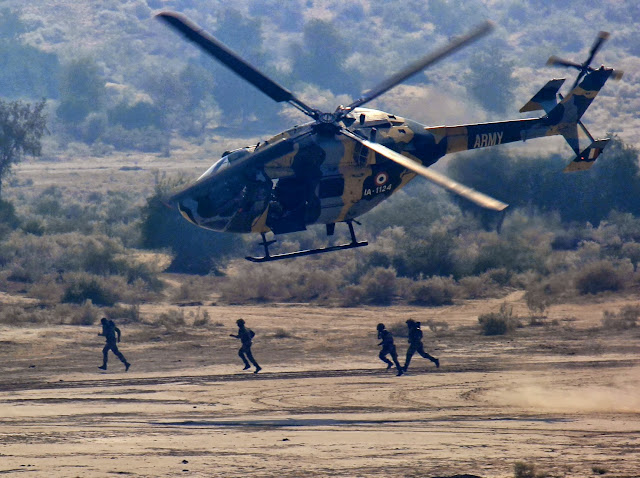
The Indian Army will be handed over the first two weapon system integrated (WSI) version of Advanced Light Helicopter (ALH-Mk-IV) Rudra, during Aero India 2013.
Hindustan Aeronautics Ltd (HAL) chairman R K Tyagi told Express that Rudra will also be available for customer demonstration flights during the show. "Rudra will definitely add more teeth to Indian Army and we will roll out more production units to the squadron," he said.
Express had earlier reported that around 70 Rudras will fly out of HAL to meet Army's initial requirements.
"In addition to the redundant flight critical systems, IR suppressor, armour panels, crashworthy features and self-sealing fuel tanks enhance the survivability of the helicopter in the battlefield environment," Tyagi said.
Rudra can carry a mix of weapons providing it with capability to search and destroy any target. Systems like electro-optic pod, helmet-mounted sight and fixed sight facilitating firing of the onboard weapons (20 mm turret gun, 70mm rockets and Air-to-Air missiles), makes it an unforgiving machine.
He said Rudra's rigid rotors have extremely high agility and manoeuvrability. With its high-powered engine, the chopper can undertake missions up to altitudes of six km. "With such capabilities, Rudra is unmatched in the world, in its class," claims Tyagi.
He confirmed that HAL has plans to integrate additional new systems on Rudra, including infra-red jammer, data link, obstacle avoidance system (for Army), wire cutter (for IAF) and NBC (Nuclear Biological and Chemical) sensors.
When asked about ALH Dhruv's (earlier version of Rudra) export status, Tyagi said three more countries have shown interest in these choppers.
Over 130 Dhruv helicopters are in operation now, with Indian Army flying 110 and 12 with Indian civil operators.
Ecuador, Nepal, Mauritius and Maldives also operate Dhruv choppers.

Saturday, September 8, 2012
India Plans Robots To Replace Soldiers
http://www.aviationweek.com/Article.aspx?id=/article-xml/asd_12_15_2011_p04-03-405438.xml

NEW DELHI — Indian scientists are in the process of developing robots to replace human soldiers in the near future as part of the country’s unmanned warfare system.
A new research facility has been set up by the Defense Research and Development Organization (DRDO) and BEML Ltd., the state-run heavy engineering and defense equipment major, in Avadi, a suburb of Chennai in south India, to make robot soldiers and cargo-transporting robots for the country’s army.
“Whatever a soldier will do in warfare, a robot soldier should be able to do. If the human is doing a search in warfare, the robot soldier will also do that. If a human is doing firefighting, the robot soldier will do that,” says V.K. Saraswat, DRDO’s director general and scientific adviser to India’s defense minister. “The DRDO is working on the project to have robot soldiers by 2020 or 2030,” he says.
The robot soldiers will be able to perform duties including carrying loads of ammunition and payloads for mine detection and surveillance. Saraswat says they can be controlled from remote locations, which would help the country’s armed forces by not having to deploy people in areas which are difficult to access. “Such a robot needs a database and artificial intelligence to carry out its activities,” Saraswat says. “A lot of effort and coordination among various agencies in the defense sector [will be] needed to develop these robots.”
The new robot soldiers are likely to replace at least some of India’s 100,000 soldiers.
In a separate project, DRDO is planning to design robotic mules that can replace the animals used by Indian soldiers to carry heavy loads in mountainous terrain.

NEW DELHI — Indian scientists are in the process of developing robots to replace human soldiers in the near future as part of the country’s unmanned warfare system.
A new research facility has been set up by the Defense Research and Development Organization (DRDO) and BEML Ltd., the state-run heavy engineering and defense equipment major, in Avadi, a suburb of Chennai in south India, to make robot soldiers and cargo-transporting robots for the country’s army.
“Whatever a soldier will do in warfare, a robot soldier should be able to do. If the human is doing a search in warfare, the robot soldier will also do that. If a human is doing firefighting, the robot soldier will do that,” says V.K. Saraswat, DRDO’s director general and scientific adviser to India’s defense minister. “The DRDO is working on the project to have robot soldiers by 2020 or 2030,” he says.
The robot soldiers will be able to perform duties including carrying loads of ammunition and payloads for mine detection and surveillance. Saraswat says they can be controlled from remote locations, which would help the country’s armed forces by not having to deploy people in areas which are difficult to access. “Such a robot needs a database and artificial intelligence to carry out its activities,” Saraswat says. “A lot of effort and coordination among various agencies in the defense sector [will be] needed to develop these robots.”
The new robot soldiers are likely to replace at least some of India’s 100,000 soldiers.
In a separate project, DRDO is planning to design robotic mules that can replace the animals used by Indian soldiers to carry heavy loads in mountainous terrain.
Friday, August 17, 2012
Indian Army gets battle-ready on Jaisalmer border with Pakistan with model modern military station
Move seen part of the cold start doctrine in which Indian armored column will move in to occupy Pakistan in case Pakistan government abdicates or collapses to Taliban militants
South Punjab - Multan, Quetta in Balochistan and Karachi will be the main thrust using the Indus valley for transportation


Jaisalmer is set to house the first “model modern military station” of the country with reduced response time to emergencies, battle-ready capabilities in modern warfare and a set up critical to the supply chain for army rationing.
According to highly placed sources, the Indian Army has decided to develop a modern army base in the border district to cut down on the response time to an emergency, including a reduction in travel time in case of a disturbance along the border. It’s proximity to the international border of India and Pakistan, has got the army to reap the benefits of this strategic location for securing the nation against any foreign aggression in future. At present, the army base at Jodhpur is trained to respond to a situation across the border, but to expedite heavy military movement, a station close to the border is being put up, sources said. The distance from Jodhpur to the border is around 300 km. Having a base at Jaisalmer would save at least 6-7 hours for the troops. “In case of disturbance or war-like situation, when every minute counts, such a response time can turn the situation around,” a reliably placed official said, adding, “Because of its location Jaisalmer is being developed as a defence hub; the defence department has identified some places where the latest technology would be installed as a tactical ploy in modern warfare; Jaisalmer is one of them.”
However, the officer refused to divulge details about the facility that is being installed in Jaisalmer.
A senior administrative official in Jaisalmer said, “Several units have already moved from Jodhpur to Jaisalmer. And the scale of the activities clearly indicates that Indian Army has big plans for Jaisalmer.” The officer also said that the availability of land for setting up an enterprise of such scale facilitated the development of the station in Jaisalmer. “In other border districts availability of land was an issue,” the officer said.
South Punjab - Multan, Quetta in Balochistan and Karachi will be the main thrust using the Indus valley for transportation


Jaisalmer is set to house the first “model modern military station” of the country with reduced response time to emergencies, battle-ready capabilities in modern warfare and a set up critical to the supply chain for army rationing.
According to highly placed sources, the Indian Army has decided to develop a modern army base in the border district to cut down on the response time to an emergency, including a reduction in travel time in case of a disturbance along the border. It’s proximity to the international border of India and Pakistan, has got the army to reap the benefits of this strategic location for securing the nation against any foreign aggression in future. At present, the army base at Jodhpur is trained to respond to a situation across the border, but to expedite heavy military movement, a station close to the border is being put up, sources said. The distance from Jodhpur to the border is around 300 km. Having a base at Jaisalmer would save at least 6-7 hours for the troops. “In case of disturbance or war-like situation, when every minute counts, such a response time can turn the situation around,” a reliably placed official said, adding, “Because of its location Jaisalmer is being developed as a defence hub; the defence department has identified some places where the latest technology would be installed as a tactical ploy in modern warfare; Jaisalmer is one of them.”
However, the officer refused to divulge details about the facility that is being installed in Jaisalmer.
A senior administrative official in Jaisalmer said, “Several units have already moved from Jodhpur to Jaisalmer. And the scale of the activities clearly indicates that Indian Army has big plans for Jaisalmer.” The officer also said that the availability of land for setting up an enterprise of such scale facilitated the development of the station in Jaisalmer. “In other border districts availability of land was an issue,” the officer said.
Subscribe to:
Posts (Atom)